A Levels Biology (9700)•9700/12/O/N/19
A Levels Biology (9700) — 9700/12/O/N/19, Question 19
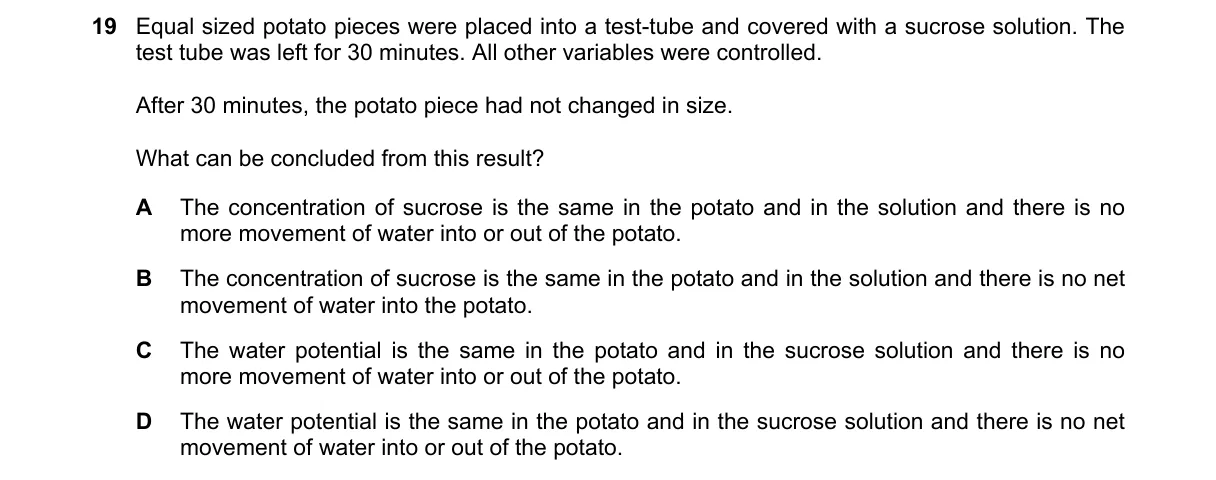
Equal sized potatoes were placed into test tubes and covered with sucrose solution. The test tube was left for 30 minutes. All other variables were controlled. After 30 minutes, the potato had not changed in size. What can be concluded from this result?
Answer choices
- AThe concentration of water is the same in the potato and in the solution and there is no movement of water into the potato.
- BThe concentration of water is the same in the potato and in the solution and there is no net movement of water into the potato.
- CThe water potential is the same in the potato and in the sucrose solution and there is no movement of water into the potato.
- DThe water potential is the same in the potato and in the sucrose solution and there is no net movement of water into or out of the potato.
Explanation
Osmosis at Equilibrium Steps:
- The potato's unchanged size indicates no net water gain or loss after 30 minutes.
- This occurs when the external sucrose solution is isotonic to the potato cells.
- Water potential must be equal between the potato and solution for equilibrium.
- At equal water potential, water diffuses in both directions with no net movement.
Why D is correct:
- Water potential equality drives no net osmosis, per the principle that water moves from high to low potential until equilibrium.
Why the others are wrong:
- A: Water concentration equality is imprecise; water potential governs osmosis, and diffusion continues bidirectionally.
- B: Focuses on water concentration, not potential; omits no net outflow.
- C: Ignores bidirectional diffusion; net movement is zero, not absolute absence into the potato.
Final answer: D
Topic: Movement into and out of cells
Practice more A Levels Biology (9700) questions on mMCQ.me