A Levels Biology (9700)•9700/12/O/N/19
A Levels Biology (9700) — 9700/12/O/N/19, Question 17
High concentrations of ethanol disrupt cell membrane structure and make the cell surface leaky. Yeast cells release ethanol as a waste product of metabolism. Yeast cells can alter the composition of the cell surface membrane to reduce the effect of ethanol. A saturated fatty acid, X, is replaced by an unsaturated fatty acid, Y. Y has a shorter hydrocarbon chain than X. There is an increase in the proportion of phospholipids. Which statement would explain why the phospholipid to protein ratio?
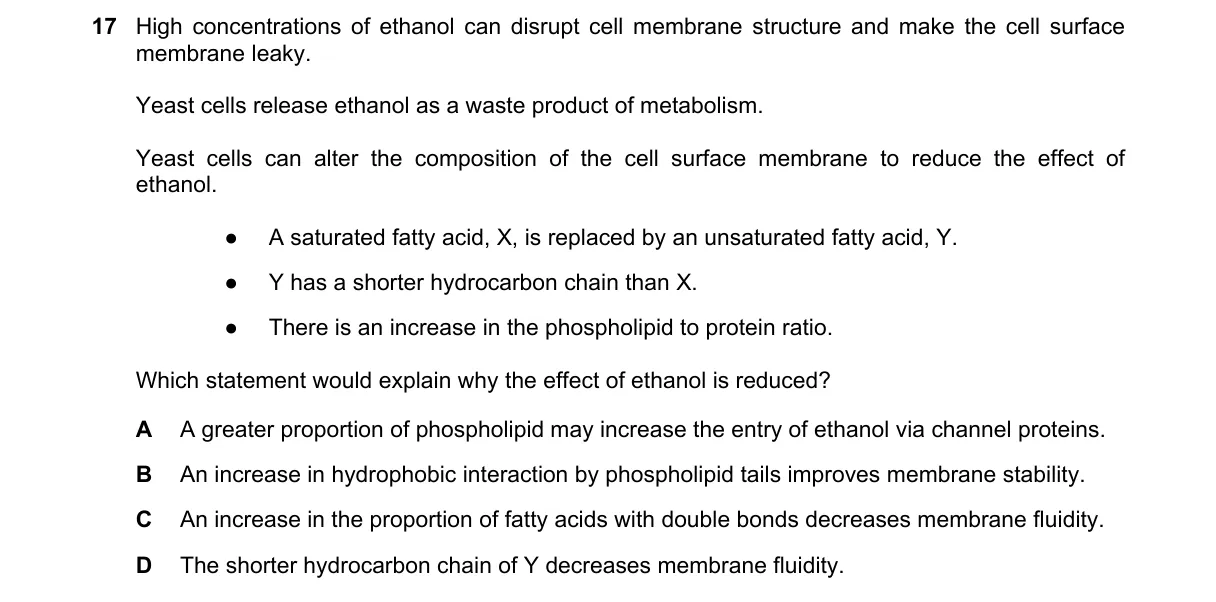
Answer choices
- AA greater proportion of phospholipids may increase the fluidity of ethanol via channel proteins.
- BAn increase in the proportion of fatty acids with double bonds improves membrane stability.
- CThe shorter hydrocarbon chain of Y decreases membrane fluidity.
- DThe shorter hydrocarbon chain of Y decreases membrane fluidity.
Explanation
Membrane adaptation using unsaturated fatty acids for ethanol tolerance
Steps:
- Ethanol disrupts membrane structure, increasing leakiness by altering fluidity.
- Replacing saturated fatty acid X with unsaturated Y introduces double bonds, which create kinks in lipid tails.
- These kinks prevent tight packing, maintaining membrane fluidity and stability against ethanol's effects.
- Increasing phospholipid proportion supports overall membrane integrity, but double bonds directly enhance stability.
Why B is correct:
- Unsaturated fatty acids with double bonds increase membrane fluidity per the fluid mosaic model, preventing rigidification or excessive disorder from ethanol, thus improving stability.
Why the others are wrong:
- A: Phospholipids do not increase "fluidity of ethanol" via channels; they form the bilayer for structural support.
- C: Shorter chains increase, not decrease, fluidity by reducing van der Waals interactions.
- D: Identical to C; shorter chains increase fluidity.
Final answer: B
Topic: Fluid mosaic membranes
Practice more A Levels Biology (9700) questions on mMCQ.me