A Levels Biology (9700)•9700/12/O/N/19
A Levels Biology (9700) — 9700/12/O/N/19, Question 15
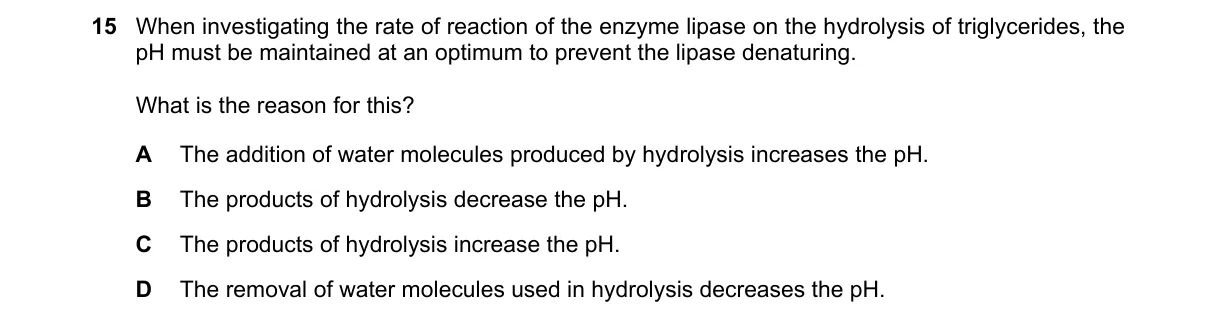
When investigating the rate of reaction of the enzyme lipase on the hydrolysis of triglycerides, the pH must be maintained at optimum to prevent the lipase denaturing. What is the reason for this optimum to prevent the lipase denaturing?
Answer choices
- AThe addition of water molecules produced by hydrolysis increases the pH.
- BThe products of hydrolysis decrease the pH.
- CThe products of hydrolysis increase the pH.
- DThe removal of water molecules used in hydrolysis decreases the pH.
Explanation
Hydrolysis produces acidic fatty acids that lower pH
Steps:
- Lipase catalyzes hydrolysis of triglycerides into glycerol and three fatty acid molecules.
- Fatty acids dissociate in water, releasing H⁺ ions.
- Increased H⁺ concentration decreases solution pH.
- Buffer maintains optimal pH to avoid denaturation from acidity.
Why B is correct:
- Hydrolysis yields fatty acids, weak acids that increase [H⁺] per the definition of acids (proton donors), lowering pH.
Why the others are wrong:
- A: Hydrolysis consumes water, not produces it; no pH increase from water addition.
- C: Products (fatty acids) decrease pH, not increase it.
- D: Hydrolysis incorporates water into products without net removal affecting pH that way.
Final answer: B
Topic: Factors that affect enzyme action
Practice more A Levels Biology (9700) questions on mMCQ.me