A Levels Biology (9700)•9700/11/O/N/19
A Levels Biology (9700) — 9700/11/O/N/19, Question 5
The antibiotic chloramphenicol inhibits protein synthesis in mitochondria and in some prokaryotic cells. Chloramphenicol does not inhibit protein synthesis in the cytoplasm of eukaryotic cells. What would be the effect on the rate of ATP production and transcription of nuclear DNA in eukaryotic cells of a person being treated with chloramphenicol?
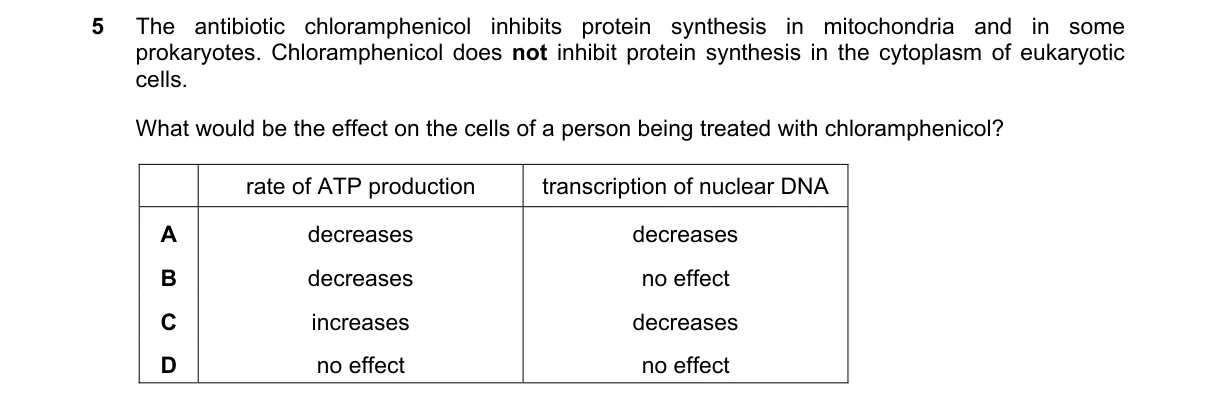
Answer choices
- Adecreases, no effect
- Bdecreases, decreases
- Cincreases, decreases
- Dno effect, no effect
Explanation
Chloramphenicol Targets Mitochondrial Protein Synthesis
Steps:
- Chloramphenicol inhibits protein synthesis in mitochondria, disrupting ATP production via oxidative phosphorylation.
- Mitochondrial proteins are essential for the electron transport chain, so inhibition reduces ATP yield.
- Nuclear DNA transcription occurs in the nucleus and uses cytoplasmic ribosomes, unaffected by the antibiotic.
- Thus, ATP production decreases while nuclear transcription remains unchanged.
Why A is correct:
- It matches the selective inhibition: mitochondrial ATP synthesis declines, but cytoplasmic/nuclear processes continue normally.
Why the others are wrong:
- B: Nuclear transcription is not inhibited, as it relies on eukaryotic ribosomes.
- C: ATP production decreases, not increases, due to mitochondrial impairment.
- D: ATP production is affected by mitochondrial protein synthesis inhibition.
Final answer: A
Topic: Respiration
Practice more A Levels Biology (9700) questions on mMCQ.me