A Levels Biology (9700)•9700/11/O/N/19
A Levels Biology (9700) — 9700/11/O/N/19, Question 40
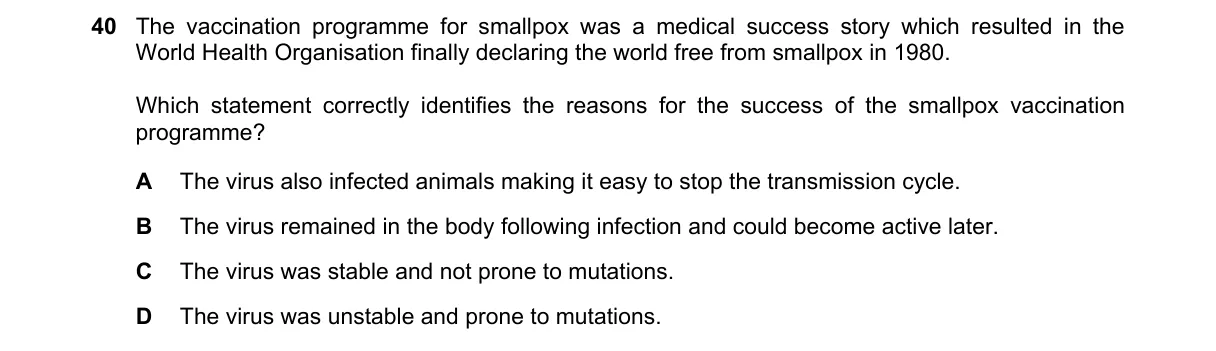
The vaccination programme for smallpox was a medical success story which resulted in the World Health Organisation finally declaring the world free from smallpox in 1980. Which statement correctly identifies the reasons for the success of the smallpox vaccination programme?
Answer choices
- AThe virus did not infect animals making it easy to stop the transmission of the smallpox.
- BThe virus remained in the body after infection and could become active later.
- CThe virus was stable and not prone to mutations.
- DThe virus was unstable and prone to mutations.
Explanation
Genetic Stability of Smallpox Virus Key to Eradication Success
Steps:
- Evaluate options based on virology of variola virus: human-specific, non-latent, DNA-based stability.
- Eliminate B and D as they describe latency or high mutation, which variola lacks.
- Confirm A as a factor but not the sole reason; stability ensured vaccine efficacy.
- Select C as it directly enabled consistent, lifelong immunity via unchanging antigens.
Why C is correct:
- Variola's DNA genome is stable with low mutation rates, allowing a single vaccine formulation to induce durable immunity without antigenic drift, per principles of viral evolution.
Why the others are wrong:
- A: True for no animal reservoir, but eradication required stable vaccine targets too.
- B: Smallpox causes acute infection without latency or reactivation.
- D: Contradicts C; variola's stability prevented mutations that could evade vaccines.
Final answer: C
Topic: Antibodies and vaccination
Practice more A Levels Biology (9700) questions on mMCQ.me