A Levels Biology (9700)•9700/11/O/N/19
A Levels Biology (9700) — 9700/11/O/N/19, Question 37
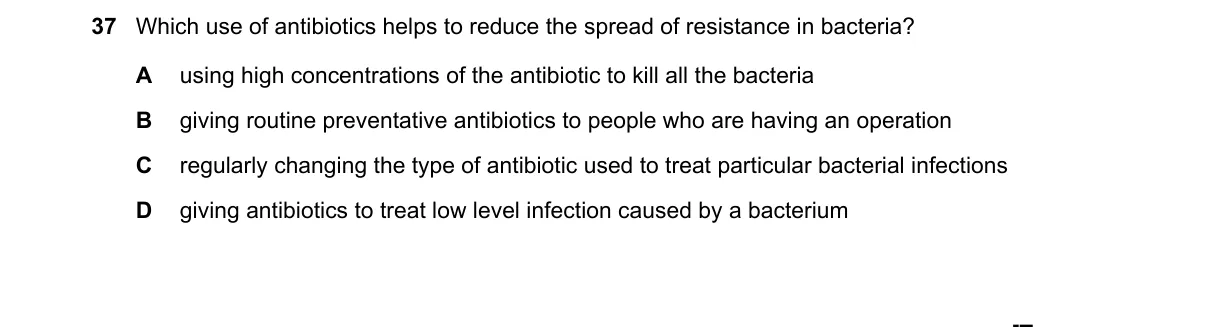
Which use of antibiotics helps to reduce the spread of resistance in bacteria?
Answer choices
- Ausing high concentrations of the antibiotic to kill all bacteria
- Bgiving routine preventive antibiotics to people who are having operations
- Cregularly changing the type of antibiotic used to treat particular bacterial infections
- Dgiving antibiotics to treat low level infection caused by bacteria
Explanation
Antibiotic Rotation to Combat Resistance
Steps:
- Identify the goal: Reduce bacterial resistance by minimizing selective pressure on populations.
- Evaluate each option: Check if it limits exposure that allows resistant strains to survive and spread.
- Consider resistance mechanisms: Bacteria evolve resistance through mutations or gene transfer under antibiotic stress.
- Select the strategy: Choose the one that diversifies pressure to prevent dominance of any single resistant type.
Why C is correct:
- Rotating antibiotics disrupts adaptation by exposing bacteria to varying drugs, preventing widespread resistance as per evolutionary principles of selective pressure.
Why the others are wrong:
- A: High concentrations can kill most bacteria but survivors are highly resistant, accelerating spread.
- B: Routine prophylaxis increases unnecessary exposure, promoting resistance in non-infected populations.
- D: Treating low-level infections uses sub-lethal doses, allowing partial survival and resistance selection.
Final answer: C
Topic: Antibiotics
Practice more A Levels Biology (9700) questions on mMCQ.me