A Levels Biology (9700)•9700/11/O/N/19
A Levels Biology (9700) — 9700/11/O/N/19, Question 26
Irrigating crop plants with water containing low concentrations of salt causes an increase in the salt concentration in the soil. What explains why this increase in salt concentration could eventually kill the crop?
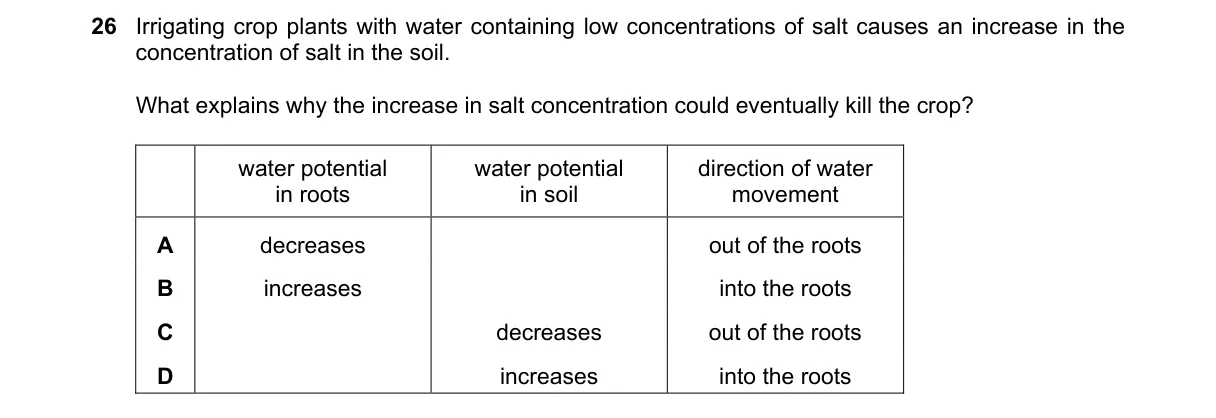
Answer choices
- Awater potential in roots decreases, water potential in soil , direction of water movement out of the roots
- Bwater potential in roots increases, water potential in soil decreases, direction of water movement out of the roots
- Cwater potential in roots , water potential in soil decreases, direction of water movement into the roots
- Dwater potential in roots , water potential in soil increases, direction of water movement into the roots
Explanation
Osmotic stress from soil salinization reverses water flow
Steps:
- Repeated irrigation concentrates salts in soil as water is absorbed or evaporates, raising solute levels.
- Increased soil solutes lower soil water potential (more negative).
- Root water potential stays relatively higher than soil's.
- Water flows from higher (roots) to lower (soil) potential, exiting roots and causing dehydration.
Why C is correct:
- Water moves via osmosis from high to low water potential; soil potential decreases below root level, driving flow out of roots (reverse osmosis), starving cells of water per the water potential gradient law.
Why the others are wrong:
- A: Root potential decrease would promote water entry, not exit, worsening uptake issues incorrectly.
- B: Root potential increase mismatches reality—roots typically maintain or lower potential to draw water, not raise it.
- D: Soil potential increase (less negative) would enhance water entry into roots, opposing salinization harm.
Final answer: C
Topic: Transport mechanisms
Practice more A Levels Biology (9700) questions on mMCQ.me