A Levels Biology (9700)•9700/11/O/N/19
A Levels Biology (9700) — 9700/11/O/N/19, Question 23
Sickle cell anemia is caused by a mutation in an allele of the gene that codes for β-globin. The diagram shows the sequence of bases in a section of the coding strand of DNA for both the normal Hb^A (β-globin) and Hb^S (sickle cell β-globin) alleles. How will the mutation in the allele result in the production of an altered version of the β-globin protein?
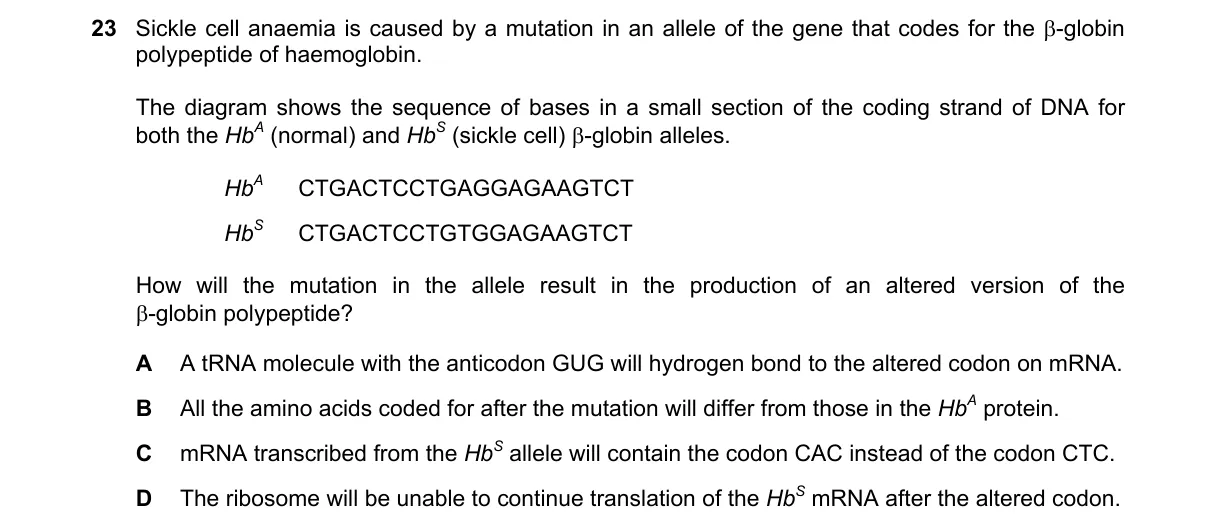
Answer choices
- AAll amino acids coded for after the GUG mutation will differ from those in the Hb^A protein.
- BmRNA transcribed from the Hb^S allele will contain the codon CAC instead of the codon CUG.
- CAll mRNA transcripts from Hb^A will contain the codon GAC instead of the codon GTC.
- DThe ribosome will be unable to continue translation of the Hb^S mRNA after the altered codon.
Explanation
Frameshift mutation alters downstream protein sequence
Steps:
- Identify the mutation type from the DNA coding strand diagram: a base insertion or deletion shifts the reading frame after the GUG codon site.
- Recognize that frameshifts change all subsequent codons, leading to different amino acids.
- Confirm the Hb^S allele produces an altered β-globin due to this shift, unlike the normal Hb^A.
- Rule out point mutations, as the diagram indicates a frameshift effect.
Why A is correct:
- Frameshift mutations, by definition, alter the reading frame, causing all amino acids after the mutation site to differ due to shifted codon boundaries.
Why the others are wrong:
- B: Hb^S mRNA has GUG (not CAC) replacing GAG; CAC/CUG are unrelated codons.
- C: Hb^A mRNA retains GAG (not GAC or GTC); this misstates normal sequence.
- D: The mutation is frameshift, not nonsense; translation continues with errors.
Final answer: A
Topic: Protein synthesis
Practice more A Levels Biology (9700) questions on mMCQ.me