A Levels Biology (9700)•9700/11/O/N/19
A Levels Biology (9700) — 9700/11/O/N/19, Question 18
A student put a layer of plant epidermal cells on a microscope slide. The student put a drop of potassium nitrate solution on the layer of cells and observed that • the cell surface membrane of many of the cells had separated from the cell wall • the cytoplasm contents had shrunk What explains these observations?
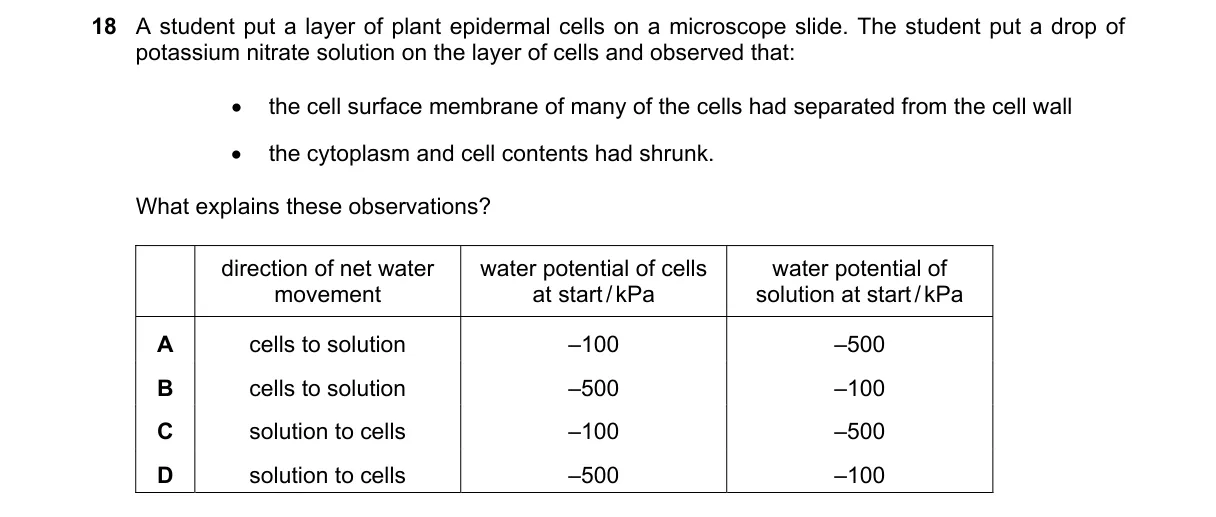
Answer choices
- ADirection of water movement: cells to solution, water potential at start /kPa: -500, water potential of solution /kPa: -500
- BDirection of water movement: solution to cells, water potential at start /kPa: -500, water potential of solution /kPa: -500
- CDirection of water movement: solution to cells, water potential at start /kPa: -100, water potential of solution /kPa: -500
- DDirection of water movement: cells to solution, water potential at start /kPa: -100, water potential of solution /kPa: -500
Explanation
Plasmolysis from hypertonic solution Steps:
- Observations show plasmolysis: membrane separates from wall and cytoplasm shrinks, indicating water loss from cells.
- Water moves by osmosis from higher water potential (less negative) to lower (more negative).
- Direction is cells to solution, as water exits cells.
- Cell water potential must exceed solution's for net outflow (e.g., -100 kPa > -500 kPa).
Why D is correct:
- Direction matches water exiting cells; cell ψ (-100 kPa) > solution ψ (-500 kPa), driving osmosis out per water potential gradient.
Why the others are wrong:
- A: Equal ψ (-500 kPa both) means no net water movement, contradicting plasmolysis.
- B: Wrong direction (into cells) and equal ψ prevent water loss.
- C: Wrong direction (into cells) despite ψ gradient favoring outflow.
Final answer: D
Topic: Movement into and out of cells
Practice more A Levels Biology (9700) questions on mMCQ.me