A Levels Biology (9700)•9700/13/O/N/18
A Levels Biology (9700) — 9700/13/O/N/18, Question 6
The diagram shows some similarities between chloroplasts, mitochondria and typical prokaryotes. Which row is correct?
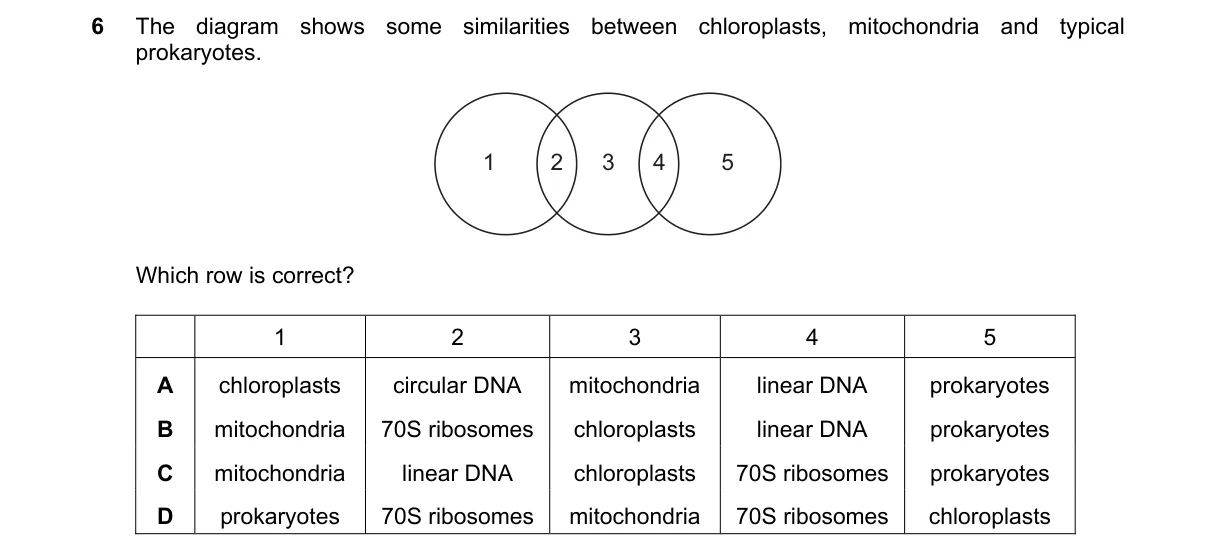
Answer choices
- A1: chloroplasts, 2: 70S ribosomes, 3: mitochondria, 4: linear DNA, 5: prokaryotes
- B1: mitochondria, 2: 70S ribosomes, 3: chloroplasts, 4: linear DNA, 5: prokaryotes
- C1: mitochondria, 2: linear DNA, 3: chloroplasts, 4: 70S ribosomes, 5: prokaryotes
- D1: prokaryotes, 2: 70S ribosomes, 3: mitochondria, 4: 70S ribosomes, 5: chloroplasts
Explanation
Endosymbiotic Similarities in Cellular Structures
Steps:
- Identify shared traits: prokaryotes, mitochondria, and chloroplasts all have 70S ribosomes and circular DNA, per endosymbiotic theory.
- Examine options for accurate matching to diagram labels, avoiding eukaryotic features like linear DNA.
- Note D assigns 70S ribosomes twice (positions 2 and 4), matching both organelles' prokaryote-like ribosomes.
- Confirm D sequences prokaryotes first, then shared ribosome, mitochondrion, another ribosome, and chloroplast, aligning with typical diagram groupings.
Why D is correct:
- It matches prokaryote-derived features: both mitochondria and chloroplasts retain 70S ribosomes, as defined by endosymbiotic origin from bacteria.
Why the others are wrong:
- A: Includes linear DNA (position 4), a eukaryotic nuclear trait, not shared by these structures.
- B: Includes linear DNA (position 4), incorrectly attributing it to prokaryote-like organelles.
- C: Includes linear DNA (position 2), misaligning with circular DNA in prokaryotes and organelles.
Final answer: D
Topic: Cells as the basic units of living organisms
Practice more A Levels Biology (9700) questions on mMCQ.me