A Levels Biology (9700)•9700/13/O/N/18
A Levels Biology (9700) — 9700/13/O/N/18, Question 32
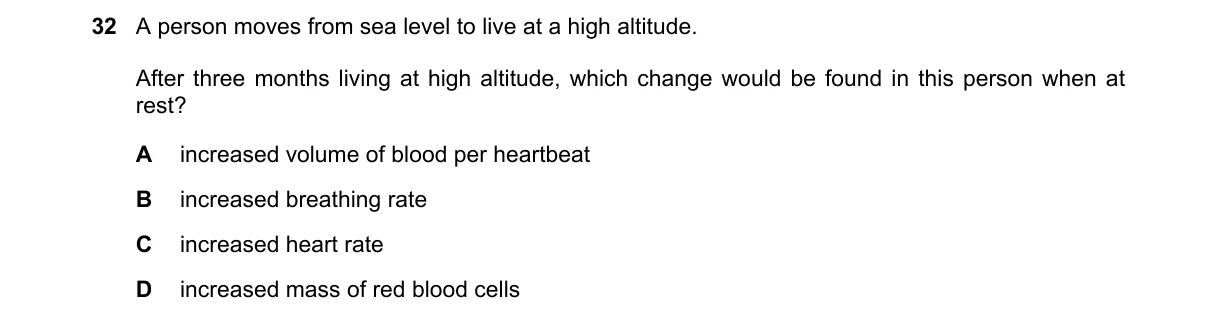
A person moves from sea level to live at high altitude. After three months living at high altitude, which change would be found in this person at rest?
Answer choices
- Aincreased volume of blood per heartbeat
- Bincreased breathing rate
- Cincreased heart rate
- Dincreased mass of red cells
Explanation
High-altitude acclimatization increases red blood cell mass
Steps:
- Low oxygen at high altitude triggers hypoxia-inducible factor, stimulating erythropoietin release.
- Erythropoietin promotes bone marrow production of red blood cells over weeks to months.
- After three months, chronic adaptation results in higher red cell mass to enhance oxygen transport.
- At rest, this polycythemia persists without acute cardiovascular strain.
Why D is correct:
- Hypoxia induces erythropoiesis via erythropoietin, increasing red blood cell mass to improve oxygen-carrying capacity, as defined by the hormone's role in stimulating erythroid progenitors.
Why the others are wrong:
- A: Stroke volume decreases chronically due to reduced plasma volume and right ventricular strain.
- B: Breathing rate increases acutely but normalizes at rest after acclimatization.
- C: Heart rate elevates initially but returns to baseline or lower at rest long-term.
Final answer: D
Topic: Transport of oxygen and carbon dioxide
Practice more A Levels Biology (9700) questions on mMCQ.me