A Levels Biology (9700)•9700/13/O/N/18
A Levels Biology (9700) — 9700/13/O/N/18, Question 18
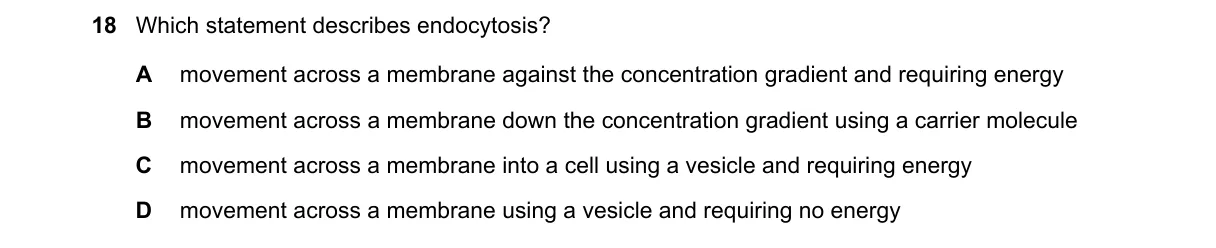
Which statement describes endocytosis?
Answer choices
- Amovement across a membrane against the concentration gradient using carrier molecule
- Bmovement across a membrane down the concentration gradient using carrier molecule
- Cmovement across a membrane into a cell using a vesicle and requiring energy
- Dmovement across a membrane using a vesicle and requiring no energy
Explanation
Endocytosis Involves Energy-Dependent Vesicle Formation
Steps:
- Define endocytosis as the cellular process of taking in substances by enclosing them in a membrane-bound vesicle.
- Identify key features: it moves materials into the cell and requires ATP energy as an active transport mechanism.
- Evaluate choices: A and B describe carrier-mediated transport (active or passive), not vesicle-based; D omits energy requirement.
- Select C as it matches the definition of endocytosis precisely.
Why C is correct:
- Endocytosis is defined as active transport where cells engulf particles or fluids into vesicles, requiring energy (ATP) to deform the membrane and form the vesicle.
Why the others are wrong:
- A describes active transport via carrier proteins, like the sodium-potassium pump, not vesicles.
- B describes facilitated diffusion, a passive process down the gradient using carriers, without vesicles.
- D describes passive vesicle transport, but endocytosis specifically requires energy, unlike exocytosis in some contexts.
Final answer: C
Topic: Movement into and out of cells
Practice more A Levels Biology (9700) questions on mMCQ.me