A Levels Biology (9700)•9700/13/O/N/18
A Levels Biology (9700) — 9700/13/O/N/18, Question 17
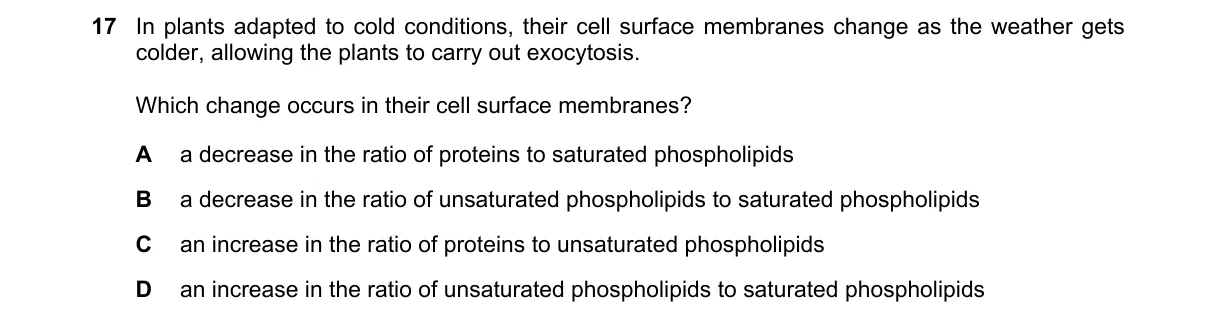
In plants adapted to cold conditions, their cell surface membranes change as the weather gets colder, allowing the plants to carry out exocytosis. Which change occurs in their cell surface membranes?
Answer choices
- Aa decrease in the ratio of unsaturated to saturated phospholipids
- Ba decrease in the ratio of unsaturated phospholipids to saturated phospholipids
- Can increase in the ratio of unsaturated to saturated phospholipids
- Dan increase in the ratio of unsaturated phospholipids to saturated phospholipids
Explanation
Cold adaptation increases membrane fluidity
Steps:
- Cold temperatures reduce membrane fluidity, hindering exocytosis by making membranes rigid.
- Saturated phospholipids pack tightly, decreasing fluidity; unsaturated ones have double bonds creating kinks for looser packing.
- Plants adapt by synthesizing more unsaturated phospholipids to maintain fluidity.
- This raises the ratio of unsaturated to saturated phospholipids.
Why D is correct:
- Unsaturated phospholipids lower the membrane's gel-to-liquid crystalline transition temperature, preserving fluidity for processes like exocytosis in cold (principle of lipid packing in fluid mosaic model).
Why the others are wrong:
- A: Decreasing the ratio increases saturation, rigidifying the membrane and impairing exocytosis.
- B: Same as A; reduces unsaturated proportion, worsening cold rigidity.
- C: Phrasing implies increase but omits "phospholipids" specificity; D precisely matches the adaptation.
Final answer: D
Topic: Fluid mosaic membranes
Practice more A Levels Biology (9700) questions on mMCQ.me