A Levels Biology (9700)•9700/13/O/N/18
A Levels Biology (9700) — 9700/13/O/N/18, Question 16
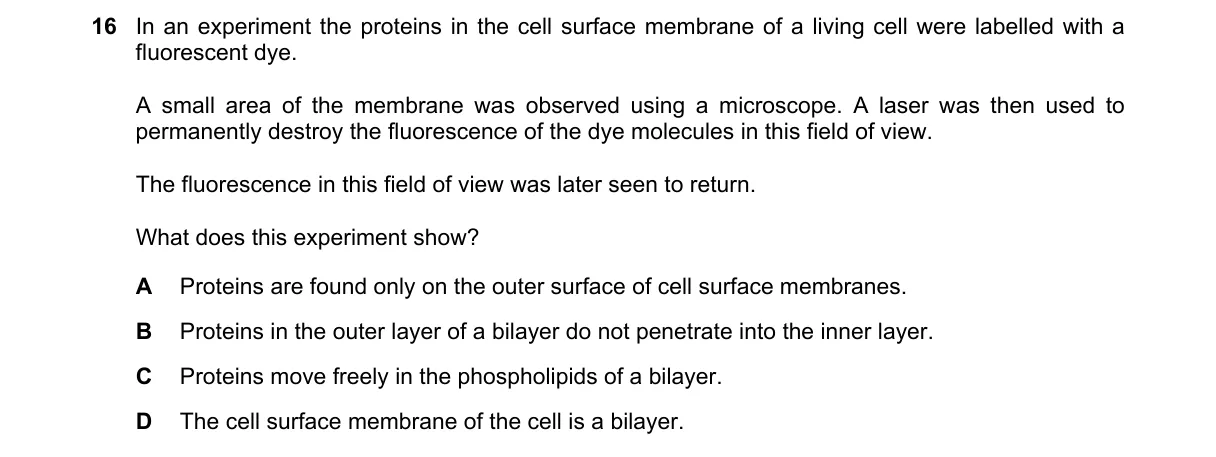
In an experiment, the proteins in the cell surface membrane of a living cell were labelled with a fluorescent dye. A small area of the membrane was observed using a microscope. A laser was then used to permanently destroy the fluorescence of the dye molecules in this field of view. The fluorescence in this field of view was later seen to return. What does this experiment show?
Answer choices
- AProteins are found only on the outer surface of cell surface membranes.
- BProteins in the outer layer of a bilayer do not enter the inner layer.
- CProteins move freely in the phospholipids of a bilayer.
- DThe cell surface membrane of the cell is a bilayer.
Explanation
Protein Mobility in Cell Membranes
Steps:
- Fluorescent dye labels membrane proteins for visualization.
- Laser bleaches fluorescence in a specific membrane area, creating a dark spot.
- Over time, fluorescence returns to the bleached area.
- Return of fluorescence indicates unbleached proteins from adjacent areas diffused into the spot.
Why C is correct:
- In the fluid mosaic model, membrane proteins exhibit lateral diffusion within the phospholipid bilayer, allowing them to move freely and repopulate the bleached region.
Why the others are wrong:
- A: Experiment shows protein movement but not exclusivity to outer surface.
- B: Focus is on lateral movement, not restriction between bilayer layers.
- D: Demonstrates membrane fluidity, not the bilayer structure itself.
Final answer: C
Topic: Fluid mosaic membranes
Practice more A Levels Biology (9700) questions on mMCQ.me