A Levels Biology (9700)•9700/13/O/N/18
A Levels Biology (9700) — 9700/13/O/N/18, Question 15
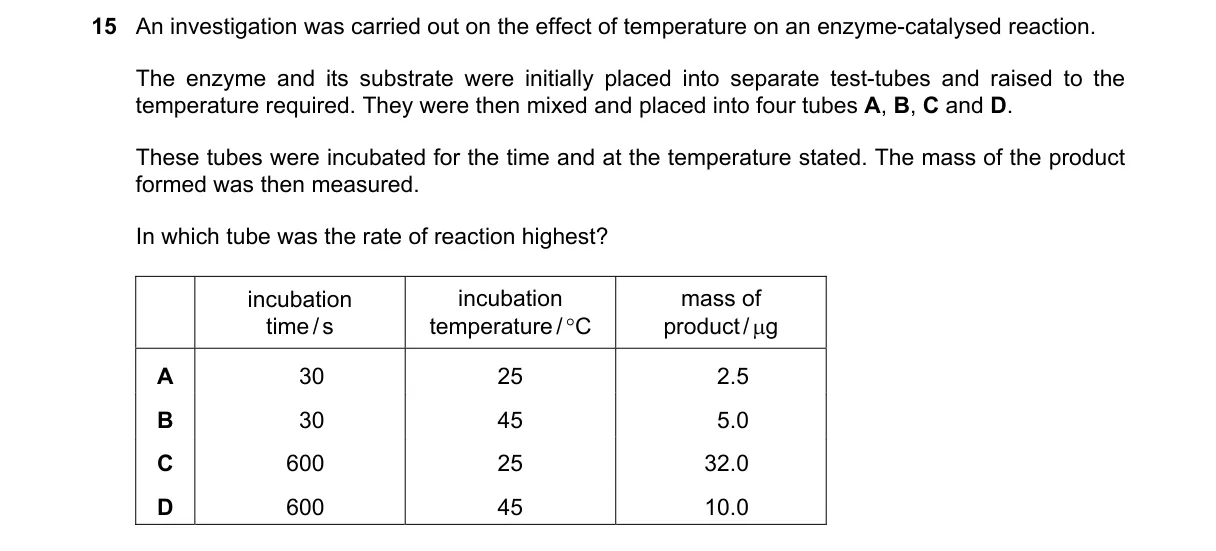
An investigation was carried out on the effect of temperature on an enzyme-catalysed reaction. The enzyme and its substrate were initially placed into separate test-tubes A, B, C and D. These tubes were incubated for the time and at the temperature stated. The mass of the product formed was measured. In which tube was the rate of reaction highest?
incubation/s | temperature/°C | mass of product/µg
A | 30 | 45 | 2.5
B | 600 | 45 | 10.0
C | 600 | 45 | 32.0
D | 600 | 45 | 10.0
Answer choices
- AOption A
- BOption B
- COption C
- DOption D
Explanation
Enzyme reaction rate depends on product formed per unit time
Steps:
- Define rate of reaction as mass of product divided by incubation time (µg/s).
- Calculate rate for tube A: 2.5 µg / 30 s = 0.083 µg/s.
- Calculate rate for tube B: 10.0 µg / 600 s = 0.017 µg/s.
- Calculate rate for tube C: 32.0 µg / 600 s = 0.053 µg/s; tube D same as B at 0.017 µg/s.
- Compare rates: A is highest.
Why A is correct:
- Rate = product mass / time per the definition of reaction rate in enzyme kinetics, yielding 0.083 µg/s for A.
Why the others are wrong:
- B: Lower rate (0.017 µg/s) due to less product relative to time.
- C: Moderate rate (0.053 µg/s), still below A's.
- D: Same low rate as B (0.017 µg/s).
Final answer: A
Topic: Factors that affect enzyme action
Practice more A Levels Biology (9700) questions on mMCQ.me