A Levels Biology (9700)•9700/13/O/N/18
A Levels Biology (9700) — 9700/13/O/N/18, Question 14
Some animals produce antimicrobial proteins which protect them from pathogens. These proteins could be used to kill pathogens, however when used as medicine they are broken down by protein-digesting enzymes. Replacing one of the amino acids found in the protein with one that had been synthesized in the laboratory resulted in a modified protein that was not broken down by the protein digesting enzymes. What could explain why this modified protein was not broken down by the protein digesting enzymes? 1 The modified protein has a different tertiary structure to the original protein. 2 The modified protein is not complementary in shape to the enzyme's active site. 3 The modified protein is unable to induce a fit with the enzyme's active site.
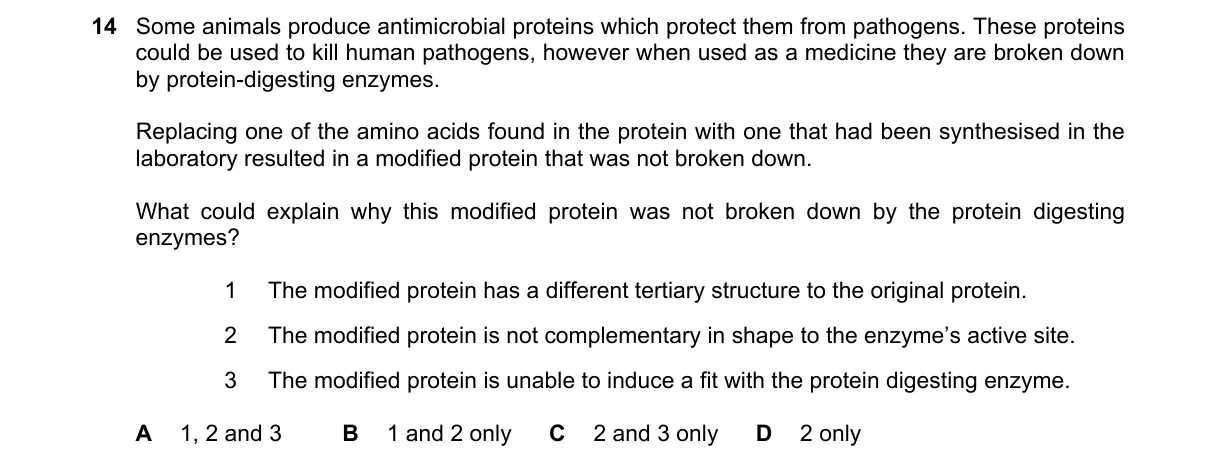
Answer choices
- A1, 2 and 3
- B1 and 2 only
- C2 and 3 only
- D2 only
Explanation
Protein Modification Disrupts Enzyme Binding
Steps:
- Amino acid replacement alters the protein's primary structure.
- This change can modify the tertiary structure by affecting folding and side-chain interactions.
- The new shape reduces complementarity to the enzyme's active site, preventing binding.
- In induced fit models, the modified protein fails to trigger conformational changes needed for catalysis.
Why A is correct:
- All three explain resistance via enzyme-substrate specificity: tertiary changes (1) alter shape for non-complementarity (2) and prevent induced fit (3), per lock-and-key and induced fit theories.
Why the others are wrong:
- B: Omits 3, but induced fit failure is a valid mechanism for non-digestion.
- C: Omits 1, but tertiary structure shifts directly result from amino acid substitution.
- D: Ignores 1 and 3, as multiple structural factors contribute to enzyme evasion.
Final answer: A
Topic: Mode of action of enzymes
Practice more A Levels Biology (9700) questions on mMCQ.me