A Levels Biology (9700)•9700/13/O/N/18
A Levels Biology (9700) — 9700/13/O/N/18, Question 13
Which statement about the typical modes of action of a competitive inhibitor and a non-competitive inhibitor is correct?
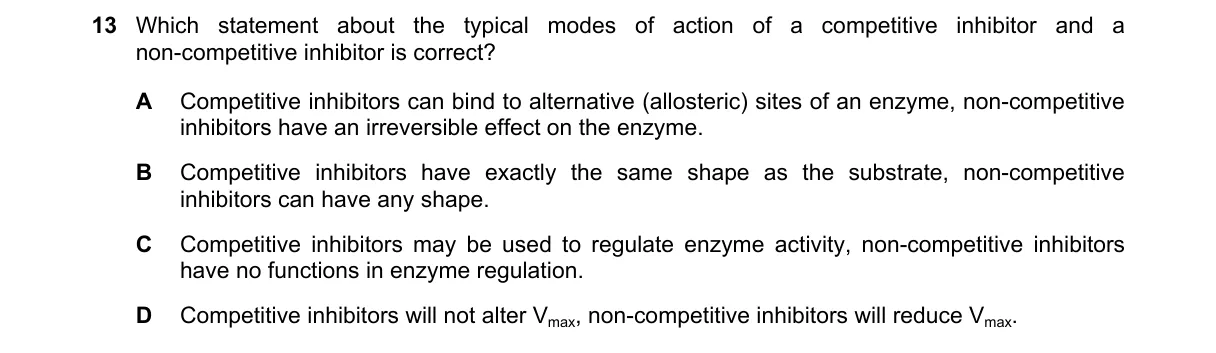
Answer choices
- ACompetitive inhibitors can bind to alternative (allosteric) sites of an enzyme, non-competitive inhibitors bind to the active site
- BCompetitive inhibitors have the same shape as the substrate, non-competitive inhibitors do not
- CCompetitive inhibitors can have any shape used to regulate enzyme activity, non-competitive inhibitors cannot
- DCompetitive inhibitors will not alter Vmax, non-competitive inhibitors will reduce Vmax
Explanation
Enzyme Inhibition Kinetics
Steps:
- Recall competitive inhibitors bind active site, competing with substrate, increasing Km but Vmax unchanged.
- Recall non-competitive inhibitors bind allosteric site, reducing enzyme activity, decreasing Vmax but Km unchanged.
- Evaluate choices against these effects on Km and Vmax.
- Identify D matches standard kinetic impacts.
Why D is correct:
- In Michaelis-Menten kinetics, competitive inhibition raises Km (apparent affinity decreases) without affecting Vmax, while non-competitive lowers Vmax by reducing effective enzyme concentration.
Why the others are wrong:
- A: Reverses binding sites—competitive bind active site, non-competitive bind allosteric.
- B: Oversimplifies shapes; competitive mimic substrate for binding, but non-competitive shapes vary without mimicking.
- C: Inaccurate; competitive typically mimic substrate shape, non-competitive can have varied shapes for allosteric binding.
Final answer: D
Topic: Mode of action of enzymes
Practice more A Levels Biology (9700) questions on mMCQ.me