A Levels Biology (9700)•9700/12/O/N/18
A Levels Biology (9700) — 9700/12/O/N/18, Question 35
Symptoms of chronic obstructive pulmonary disease (COPD) include a cough, breathlessness and chest infections. Some of the changes in the lungs that result from smoking are listed. 1 Alveoli lose elastin and collapse. 2 Bacteria accumulate in mucus. 3 Cilia are inactivated. 4 Goblet cells secrete more mucus. Which changes cause the cough in COPD?
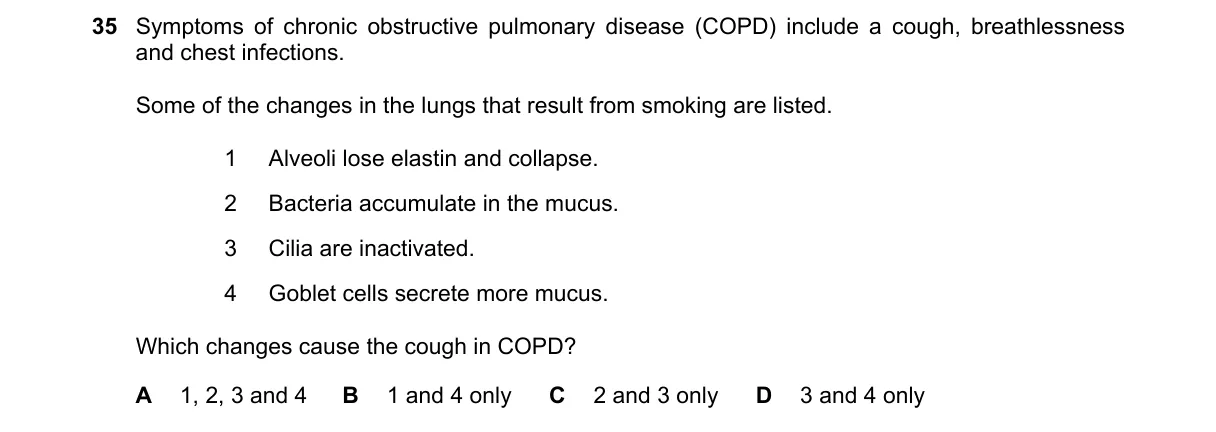
Answer choices
- A1, 2 and 4
- B1 and 3
- C2 and 3 only
- D3 and 4 only
Explanation
Mucus excess and poor clearance trigger COPD cough
Steps:
- Cough reflex clears excess mucus and irritants from airways in COPD.
- Change 4 boosts goblet cell mucus secretion, irritating airways and stimulating chronic cough.
- Change 3 inactivates cilia, blocking mucus transport and causing retention that provokes cough.
- Changes 1 and 2 impair gas exchange (emphysema) and promote infections, linking to breathlessness and acute episodes, not chronic cough.
Why D is correct:
- COPD cough stems from chronic bronchitis, defined by hyperplasia of mucus glands (change 4) and ciliary paralysis (change 3), per WHO classification.
Why the others are wrong:
- A includes 1 (alveolar collapse causes dyspnea) and 2 (bacteria cause infections, not routine cough).
- B pairs 1 (emphysema-related, not cough) with 3 (valid but incomplete).
- C includes 2 (infection trigger, not chronic mucus issue) with 3.
Final answer: D
Topic: The gas exchange system
Practice more A Levels Biology (9700) questions on mMCQ.me