A Levels Biology (9700)•9700/12/O/N/18
A Levels Biology (9700) — 9700/12/O/N/18, Question 29
What describes the role of the atrioventricular node of the heart?
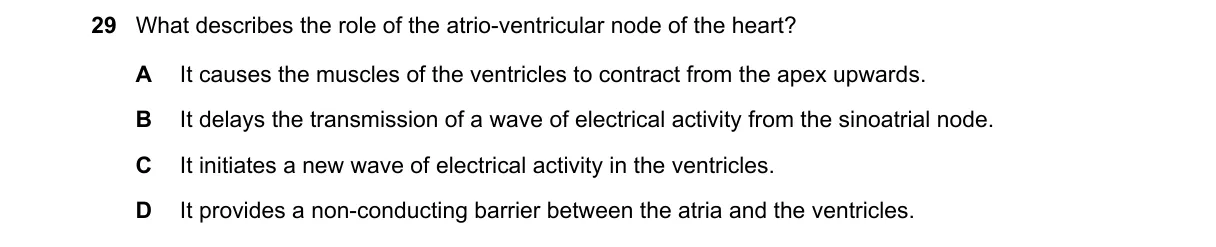
Answer choices
- AIt causes the muscles of the ventricles to contract from apex upwards.
- BIt delays the transmission of a wave of electrical activity from the sinoatrial node.
- CIt initiates a new wave of electrical activity in the ventricles.
- DIt provides a non-conducting barrier between the atria and ventricles.
Explanation
AV Node Delays Impulse for Coordinated Heartbeat
Steps:
- Recall the heart's electrical conduction system starts at the sinoatrial (SA) node in the right atrium.
- Trace the impulse path: SA node fires, spreads through atria, reaches atrioventricular (AV) node at the atrial-ventricular junction.
- Identify AV node's function: it briefly delays the impulse to allow atria to fully contract before ventricles do.
- Eliminate options by matching to conduction roles: delay fits B, while others misattribute initiation, contraction direction, or barriers.
Why B is correct:
- The AV node delays the electrical impulse by about 0.1 seconds, ensuring atrial contraction completes before ventricular depolarization begins, per cardiac physiology principles.
Why the others are wrong:
- A: Ventricular contraction direction is apex upward due to Purkinje fibers, not AV node.
- C: AV node relays but does not initiate ventricular activity; that's the bundle of His and Purkinje system.
- D: No non-conducting barrier exists; AV node conducts with delay, unlike fibrous skeleton separating atria and ventricles elsewhere.
Final answer: B
Topic: The heart
Practice more A Levels Biology (9700) questions on mMCQ.me