A Levels Biology (9700)•9700/12/O/N/18
A Levels Biology (9700) — 9700/12/O/N/18, Question 19
Agar cubes can be used to demonstrate the effect of changing surface area to volume ratio. Three different agar cubes with indicator solution that changes colour when it reacts with acid were used. The cubes were left in acid for 10 min. All other variables were kept the same. The results were recorded in the diagram. Not to scale. Which diagram represents the results for the 1 cm and 3 cm cubes?
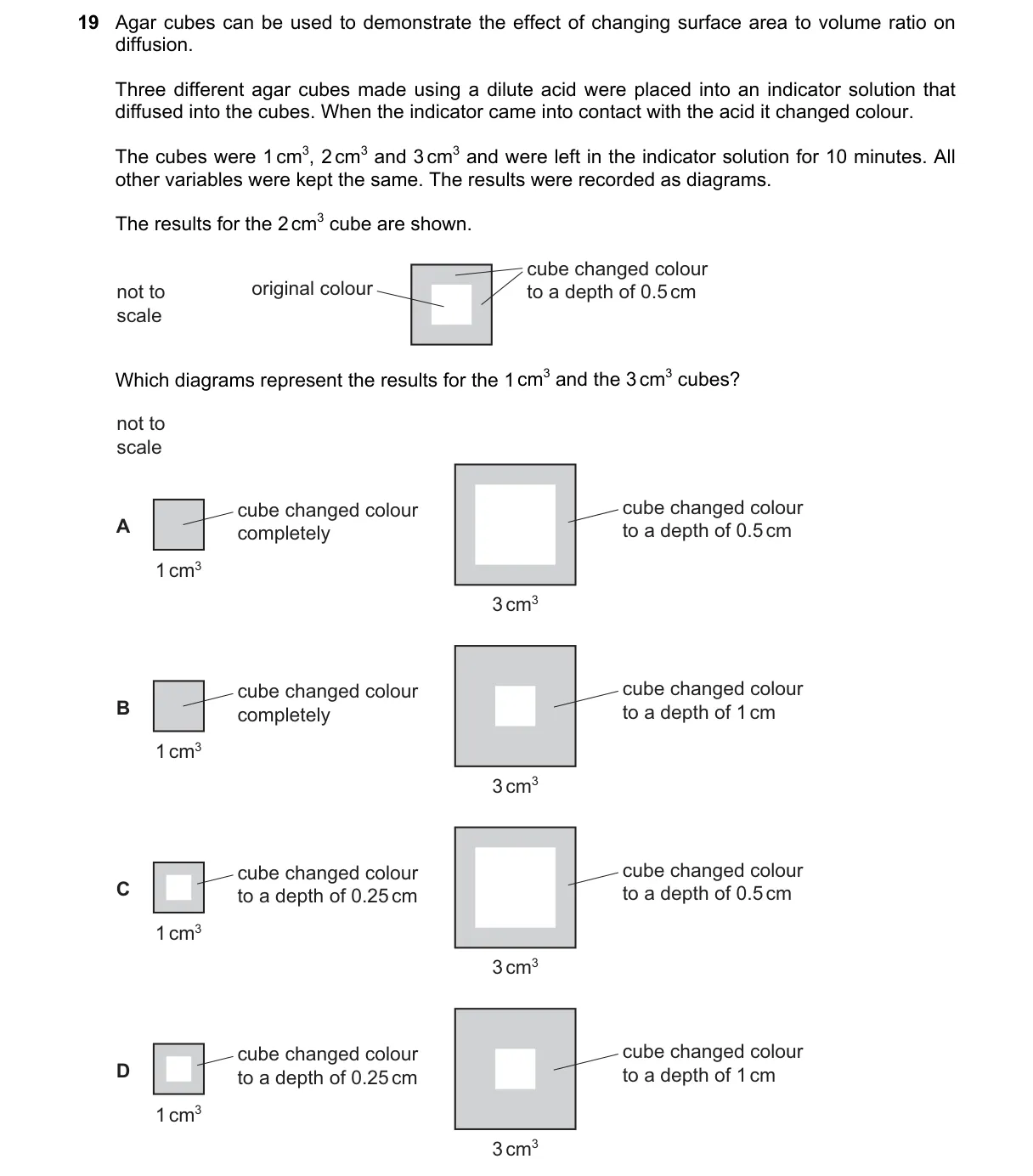
Answer choices
- A1 cm completely changed colour, 3 cm changed colour to a depth of 0.5 cm
- B1 cm completely changed colour, 3 cm changed colour to a depth of 1 cm
- C1 cm changed colour to a depth of 0.25 cm, 3 cm changed colour to a depth of 0.5 cm
- D1 cm changed colour to a depth of 0.5 cm, 3 cm changed colour to a depth of 1 cm
Explanation
Surface Area to Volume Ratio and Diffusion
Steps:
- Smaller agar cubes have higher surface area to volume (SA:V) ratios, allowing faster acid diffusion.
- 1 cm cube: SA:V = 6:1; acid penetrates fully (0.5 cm to center) in 10 min, changing color completely.
- 3 cm cube: SA:V = 2:1; acid penetrates slower, reaching only 0.5 cm depth from surface.
- Results show complete change for 1 cm and partial (0.5 cm) for 3 cm, matching option A.
Why A is correct:
- High SA:V in small cubes enables complete diffusion; low SA:V in large cubes limits penetration depth proportionally to half the side length (0.5 cm for 3 cm cube).
Why the others are wrong:
- B: 1 cm depth for 3 cm cube overestimates diffusion, ignoring reduced SA:V.
- C: 0.25 cm for 1 cm underestimates; small size allows full penetration.
- D: 0.5 cm for 1 cm underestimates full change; 1 cm for 3 cm overestimates limited diffusion.
Final answer: A
Topic: Movement into and out of cells
Practice more A Levels Biology (9700) questions on mMCQ.me