A Levels Biology (9700)•9700/12/O/N/18
A Levels Biology (9700) — 9700/12/O/N/18, Question 14
Aspirin inhibits an enzyme by reacting with an amino acid that forms an essential part of the 3D structure of the enzyme. Part of aspirin molecule binds firmly with amino acid. What describes this inhibition?
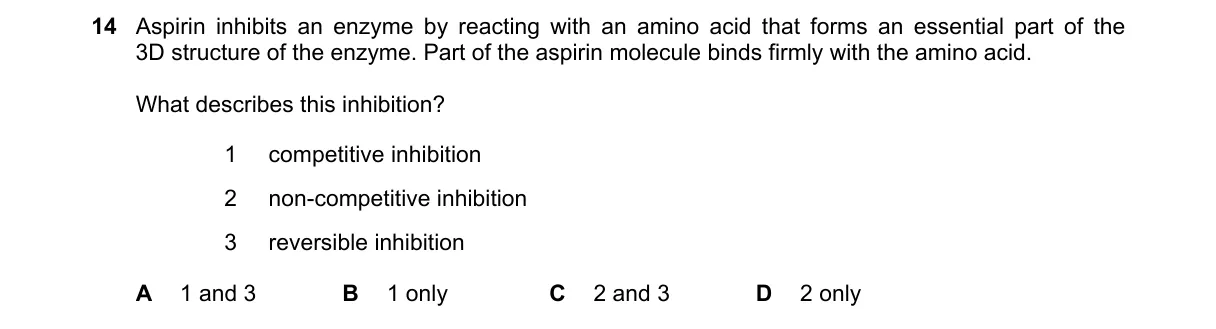
Answer choices
- A1 and 3
- B1 only
- C2 and 3
- D2 only
Explanation
Aspirin causes irreversible covalent inhibition
Steps:
- Identify the mechanism: Aspirin reacts with a serine amino acid in the enzyme's active site, forming a covalent bond.
- Classify the inhibition: This covalent modification permanently alters the enzyme's 3D structure, preventing substrate binding.
- Match to options: Assume 1=competitive, 2=irreversible, 3=non-competitive; the reaction and firm binding indicate irreversible only.
- Select answer: D fits as it specifies 2 only, excluding reversible types.
Why D is correct:
- Irreversible inhibition involves covalent bonding to essential residues, matching aspirin's acetylation of serine in COX enzyme.
Why the others are wrong:
- A includes 1 and 3: Competitive (1) is reversible; non-competitive (3) doesn't alter structure via reaction.
- B includes only 1: Competitive inhibition competes reversibly, not via covalent reaction.
- C includes 2 and 3: Non-competitive (3) binds allosterically without covalent modification.
Final answer: D
Topic: Mode of action of enzymes
Practice more A Levels Biology (9700) questions on mMCQ.me