A Levels Biology (9700)•9700/11/O/N/18
A Levels Biology (9700) — 9700/11/O/N/18, Question 28
Which statement concerning transpiration is correct?
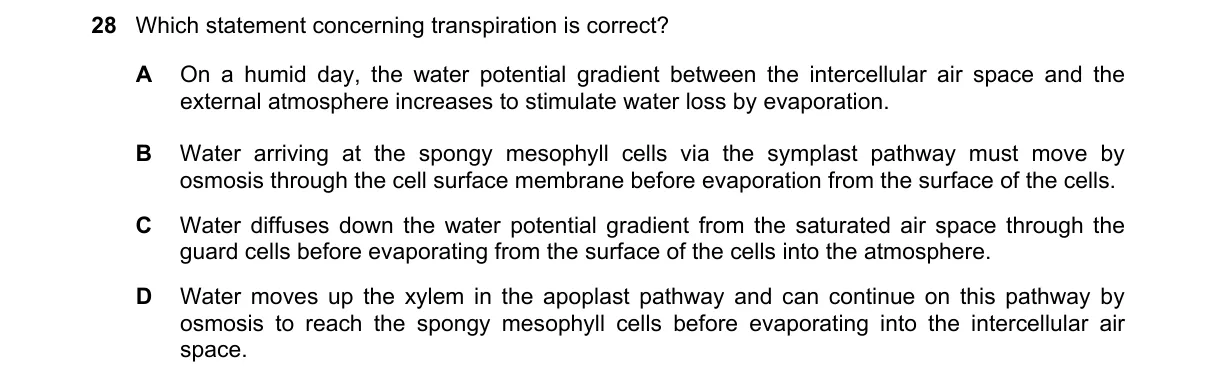
Answer choices
- AOn a humid day, the water potential gradient between the external air space and the spongy mesophyll cells via the apoplast surface into atmosphere path
- BWater arriving at the spongy mesophyll cells via the symplast pathway from the surface of the cells before evaporation into the intercellular air space and the external air space increases the potential gradient for water loss by evaporation
- CWater diffuses down the potential gradient from the saturated air space through the guard cells before evaporating from the surface of the cells
- DWater moves up the xylem in the apoplast pathway and can continue on this pathway by reaching the spongy mesophyll cells before evaporating into the intercellular air space
Explanation
Water Potential Gradients Drive Transpiration
Steps:
- Transpiration involves water evaporation from leaf mesophyll cells into air spaces, driven by water potential gradients.
- Water moves via symplast (cell-to-cell) or apoplast (cell wall) pathways to reach evaporation sites.
- Evaporation from cell surfaces into intercellular spaces creates a steep potential gradient, pulling more water.
- Humid conditions reduce the gradient between leaf air spaces and external air, slowing transpiration.
Why B is correct:
- Evaporation from wet cell surfaces into air spaces lowers water potential there, increasing the gradient that draws water via symplast, per the water potential equation (Ψ = Ψ_s + Ψ_p + Ψ_m), where evaporation reduces Ψ in air spaces.
Why the others are wrong:
- A: Humid days decrease, not increase, the external air-to-mesophyll gradient, reducing transpiration.
- C: Water doesn't diffuse from saturated air spaces through guard cells; guard cells regulate stomatal opening for gas exchange, not direct water diffusion.
- D: Apoplast pathway stops at mesophyll cell walls; water doesn't "continue" directly to cells before evaporation without crossing via osmosis.
Final answer: B
Topic: Transport mechanisms
Practice more A Levels Biology (9700) questions on mMCQ.me