A Levels Biology (9700)•9700/11/O/N/18
A Levels Biology (9700) — 9700/11/O/N/18, Question 13
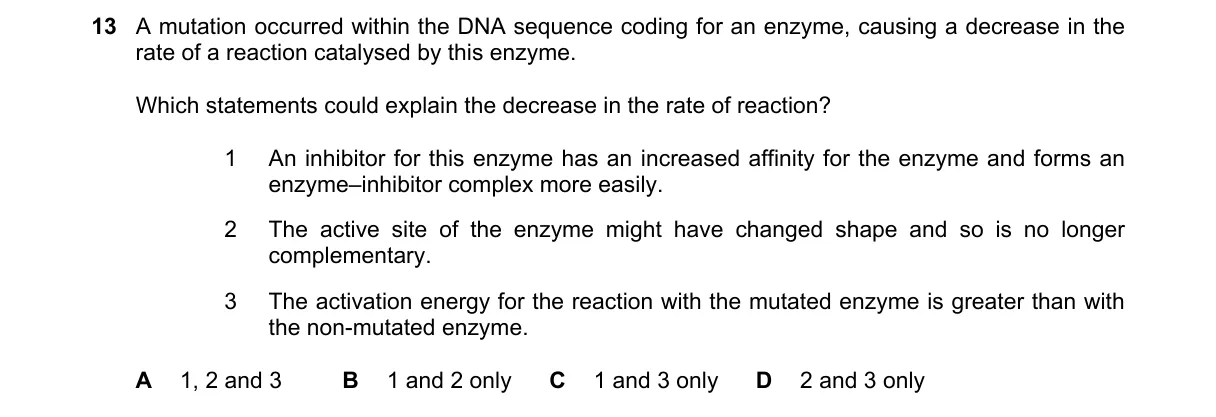
A mutation occurred within the DNA sequence coding for an enzyme, causing a decrease in the rate of reaction catalysed by this enzyme. Which statements could explain the decrease in rate? 1 An inhibitor for this enzyme forms an inhibitor complex more easily. 2 The active site of the enzyme might have changed shape and so is no longer complementary. 3 The activation energy for the reaction with the mutated enzyme is greater than with the non-mutated enzyme.
Answer choices
- A1, 2 and 3
- B1 and 2 only
- C1 and 3 only
- D2 and 3 only
Explanation
Mutation Impacts on Enzyme Kinetics
Steps:
- Statement 1: Mutation alters enzyme structure, potentially increasing inhibitor affinity and forming enzyme-inhibitor complex more easily, reducing available enzyme and reaction rate.
- Statement 2: Active site shape change eliminating complementarity prevents substrate binding entirely, implying zero rate rather than a decrease.
- Statement 3: Mutation impairs transition state stabilization, raising activation energy and slowing reaction rate per the Arrhenius equation (rate ∝ e^{-Ea/RT}).
- Select option with valid explanations (1 and 3) for decreased but ongoing catalysis.
Why C is correct:
- Combines increased inhibition (reducing effective [E]) and higher Ea (lowering k_cat via transition state theory), both yielding partial rate reduction without total inactivation.
Why the others are wrong:
- A includes 2, implying complete activity loss inconsistent with "decrease."
- B excludes 3, ignoring how mutations elevate Ea to slow catalysis.
- D excludes 1, overlooking structural changes enhancing inhibitor binding.
Final answer: C
Topic: Mode of action of enzymes
Practice more A Levels Biology (9700) questions on mMCQ.me