A Levels Biology (9700)•9700/14/M/J/25
A Levels Biology (9700) — 9700/14/M/J/25, Question 8
Diastase is an enzyme that breaks down starch into maltose. A sample of starch is treated with boiled diastase and left for 15 mins. Samples of the mixture are then tested with iodine solution and with Benedict's solution. What is the correct result?
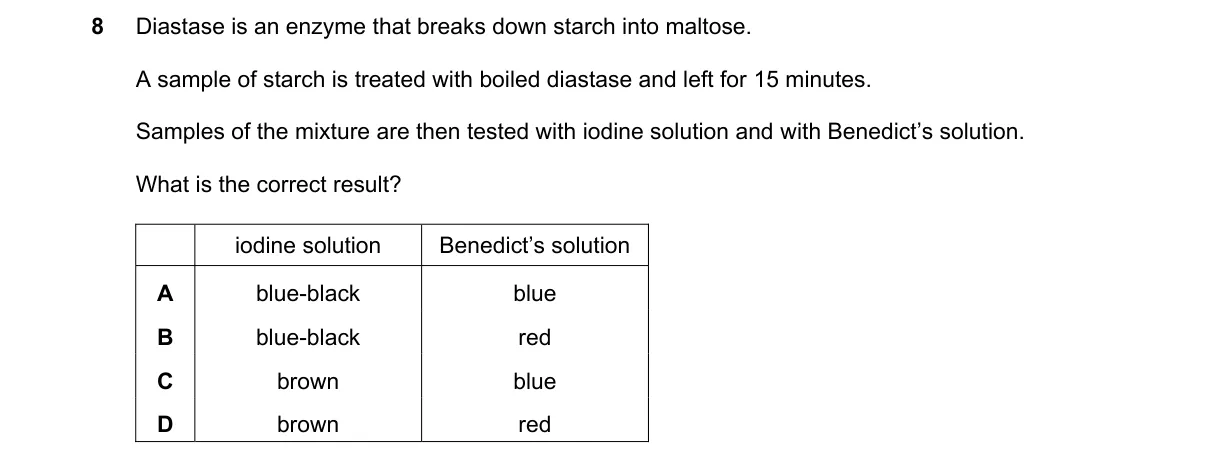
Answer choices
- Aiodine solution: blue-black, Benedict's solution: blue
- Biodine solution: blue-black, Benedict's solution: red
- Ciodine solution: brown, Benedict's solution: red
- Diodine solution: brown, Benedict's solution: blue
Explanation
Boiled diastase fails to digest starch
Steps:
- Boiling denatures diastase, rendering the enzyme inactive.
- Inactive diastase cannot hydrolyze starch into maltose over 15 minutes.
- Undigested starch reacts with iodine to form a blue-black complex.
- Absence of reducing sugars (maltose) means Benedict's solution stays blue, showing no reaction.
Why A is correct:
- Denaturation by boiling inactivates enzymes, per protein structure principles, so starch persists (blue-black with iodine) and no reducing sugars form (blue with Benedict's).
Why the others are wrong:
- B: Benedict's red indicates reducing sugars, but none are produced without active enzyme.
- C: Iodine brown suggests no starch, but undigested starch is present.
- D: Iodine brown incorrectly implies starch absence despite inactive enzyme.
Final answer: A
Topic: Factors that affect enzyme action
Practice more A Levels Biology (9700) questions on mMCQ.me