A Levels Biology (9700)•9700/14/M/J/25
A Levels Biology (9700) — 9700/14/M/J/25, Question 1
Plant cells are stained and viewed with simple light microscope, using daylight as only light source. Which structures are clearly visible at a magnification of 400?
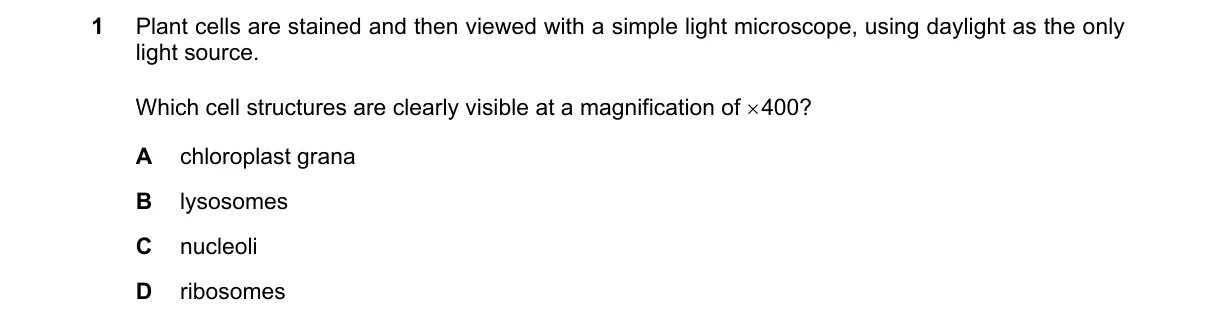
Answer choices
- AChloroplast grana
- BLysosomes
- CNucleoli
- DRibosomes
Explanation
Visibility of cellular structures under light microscopy
Steps:
- Light microscopes resolve structures larger than 0.2 μm with 400x magnification and staining.
- Daylight provides visible wavelengths (400-700 nm), limiting resolution to ~200 nm.
- Staining enhances contrast for larger organelles in plant cells.
- Compare structure sizes: nucleoli (2-5 μm) vs. smaller components like grana or ribosomes.
Why C is correct:
- Nucleoli are dense RNA-protein aggregates (1-8 μm) that stain prominently with basic dyes, exceeding light microscope resolution limits.
Why the others are wrong:
- A: Chloroplast grana are stacked thylakoids (~0.3-0.5 μm thick), below resolution without electron microscopy.
- B: Lysosomes are small vesicles (~0.1-1 μm), often obscured in plant cells and require advanced staining.
- D: Ribosomes are ~20-30 nm particles, far smaller than the 0.2 μm diffraction limit.
Final answer: C
Topic: The microscope in cell studies
Practice more A Levels Biology (9700) questions on mMCQ.me