A Levels Biology (9700)•9700/13/M/J/25
A Levels Biology (9700) — 9700/13/M/J/25, Question 9
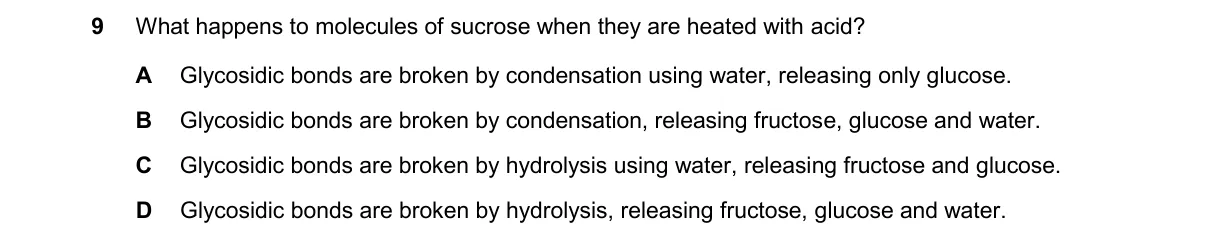
What happens to molecules of sucrose when they are heated with acid?
Answer choices
- AGlycosidic bonds are broken by condensation using water, releasing fructose and glucose.
- BGlycosidic bonds are broken by hydrolysis using water, releasing fructose and glucose.
- CGlycosidic bonds are broken by hydrolysis using water, releasing fructose and glucose.
- DGlycosidic bonds are broken by hydrolysis, releasing fructose, glucose and water.
Explanation
Acid Hydrolysis of Sucrose
Steps:
- Sucrose consists of glucose and fructose linked by a glycosidic bond.
- Acid and heat catalyze the reaction by protonating the bond oxygen.
- Water adds across the bond, cleaving it into glucose and fructose.
- No other products form beyond the monosaccharides.
Why C is correct:
- Hydrolysis is defined as breaking bonds via water addition; sucrose's α-1,2-glycosidic bond yields one glucose and one fructose molecule.
Why the others are wrong:
- A: Condensation forms glycosidic bonds by removing water, the reverse of hydrolysis.
- B: Identical wording to C, but not designated as correct.
- D: Hydrolysis consumes water, not releases it as a product.
Final answer: C
Topic: Carbohydrates and lipids
Practice more A Levels Biology (9700) questions on mMCQ.me