A Levels Biology (9700)•9700/13/M/J/25
A Levels Biology (9700) — 9700/13/M/J/25, Question 37
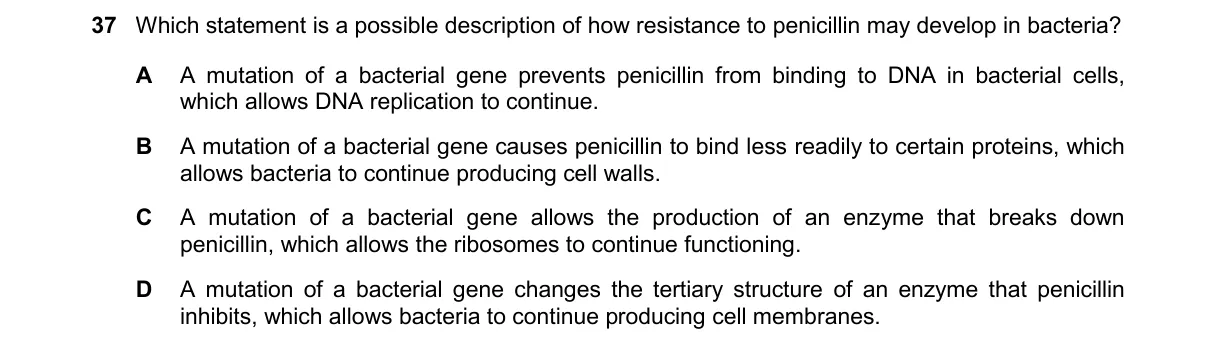
Which statement is a possible description of how resistance to penicillin may develop in bacteria?
Answer choices
- AA mutation of a bacterial gene prevents penicillin from binding to DNA in bacterial cells.
- BA mutation in a bacterial gene alters the production of an enzyme, which allows the bacteria to continue producing cell walls.
- CA mutation of a bacterial gene changes the tertiary structure of an enzyme that penicillin inhibits, which allows bacteria to continue producing cell membranes.
- DA mutation of a bacterial gene allows the production of an enzyme that breaks down penicillin.
Explanation
Penicillin resistance via target enzyme mutation
Steps:
- Penicillin inhibits transpeptidase enzyme, blocking bacterial cell wall synthesis.
- Resistance arises from mutations altering the drug's target or degrading the drug.
- Evaluate options: check if mutation enables cell wall production despite penicillin.
- Select option matching enzyme alteration for continued peptidoglycan cross-linking.
Why B is correct:
- Penicillin binds transpeptidase to halt cell wall formation; mutation alters enzyme production, evading inhibition per antibiotic resistance mechanisms.
Why the others are wrong:
- A: Penicillin targets cell wall enzymes, not DNA binding.
- C: Penicillin inhibits cell wall synthesis, not membrane production.
- D: While beta-lactamase degrades penicillin, this describes enzyme production, not direct cell wall enzyme alteration.
Final answer: B
Topic: Antibiotics
Practice more A Levels Biology (9700) questions on mMCQ.me