A Levels Biology (9700)•9700/13/M/J/25
A Levels Biology (9700) — 9700/13/M/J/25, Question 31
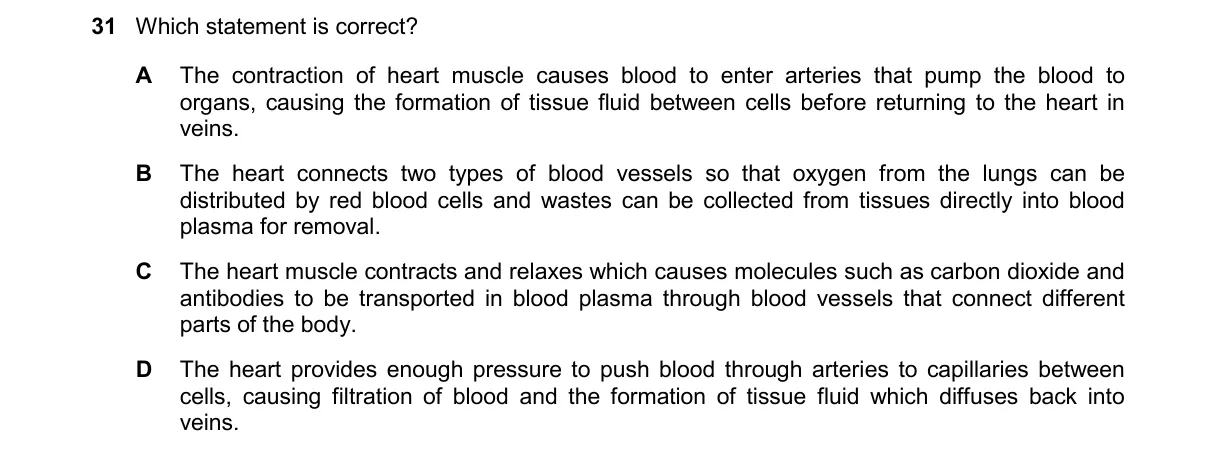
Which statement is correct?
Answer choices
- AThe contraction of heart muscle causes blood to enter arteries that pump the blood to organs, causing the formation of tissue fluid between cells before returning to the heart in veins.
- BThe heart contracts two types of waste vessels so that oxygen from the lungs can be distributed red blood cells tissue fluid can be collected from tissues directly into blood plasma for transport.
- CThe heart muscle contracts and relaxes which cause molecules such as carbon dioxide and plasma for removal.
- DThe heart provides enough pressure to push blood through arteries to capillaries between cells, causing filtration of blood and the formation of tissue fluid which diffuses back into veins.
Explanation
Heart's pumping action in circulation
Steps:
- Examine each option for accurate description of heart contraction, blood flow, and tissue exchange.
- Identify key processes: heart generates pressure for arterial flow to capillaries, forming tissue fluid; veins return blood.
- Eliminate garbled or factually incorrect statements about vessels, pumping, or diffusion.
- Confirm the option linking cardiac cycle to waste removal like CO2.
Why C is correct:
- The cardiac cycle (contraction and relaxation) circulates blood to remove waste molecules such as carbon dioxide from tissues into plasma for transport to lungs, per circulatory physiology.
Why the others are wrong:
- A: Arteries carry blood but do not pump it; heart provides the force.
- B: No "waste vessels"; statement is incoherent and misdescribes oxygen distribution and tissue fluid collection.
- D: Tissue fluid forms via capillary filtration but re-enters capillaries, not directly diffusing into veins.
Final answer: C
Topic: The circulatory system
Practice more A Levels Biology (9700) questions on mMCQ.me