A Levels Biology (9700)•9700/13/M/J/25
A Levels Biology (9700) — 9700/13/M/J/25, Question 20
A student half filled a beaker with solution X. They placed a sealed Visking tubing bag containing solution Y into the beaker. At 30 minutes, the solution in the beaker was orange and the solution inside the Visking tubing was blue-black. What did solutions X and Y contain at the start to give these results?
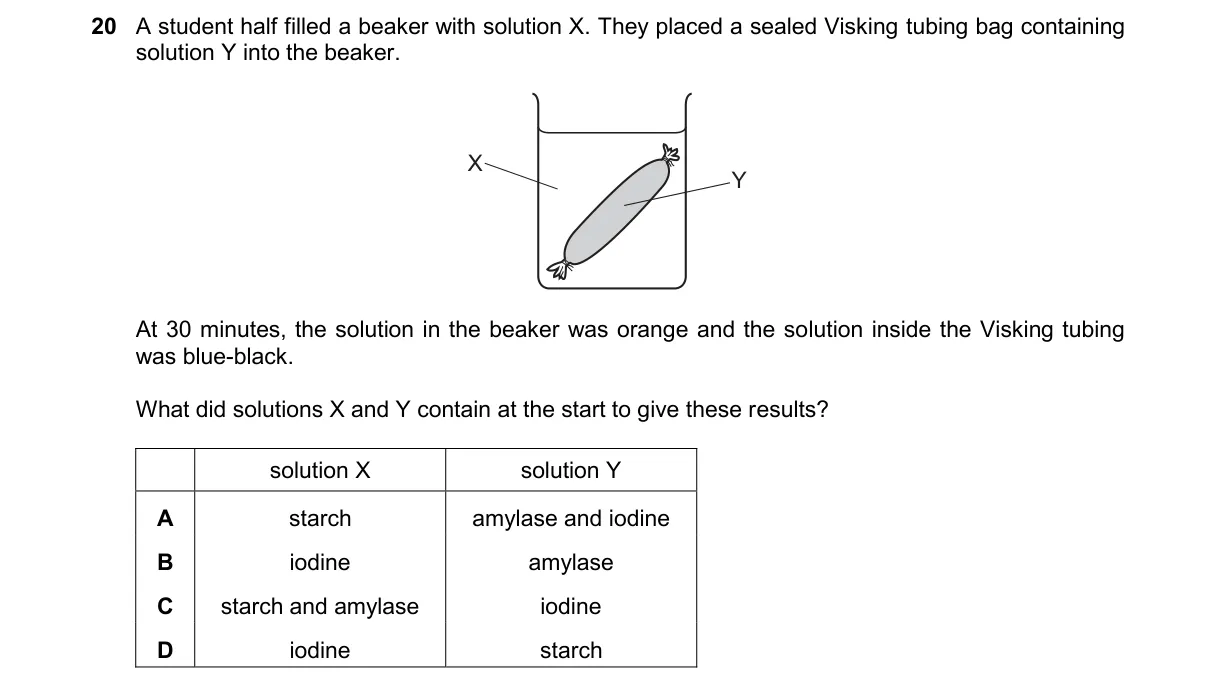
Answer choices
- Asolution X: starch, solution Y: amylase and iodine
- Bsolution X: starch and amylase, solution Y: iodine
- Csolution X: starch, solution Y: iodine
- Dsolution X: iodine, solution Y: starch
Explanation
Selective permeability and iodine-starch reaction
Steps:
- Visking tubing allows small molecules like iodine to diffuse through but blocks large molecules like starch.
- After 30 minutes, blue-black color inside the bag indicates starch reacting with iodine, so starch must be in Y and iodine diffuses from X.
- Orange color in the beaker suggests iodine solution (often orange-brown) remaining after diffusion, confirming X contains iodine.
- No enzyme activity implied, as colors result from diffusion and reaction alone.
Why D is correct:
- Visking tubing's semi-permeable nature permits iodine (small molecule) to enter the bag and form blue-black complex with starch, per diffusion principles.
Why the others are wrong:
- A: Amylase would digest starch to maltose (no blue-black); iodine in Y can't explain orange beaker.
- B: Amylase in X digests starch before iodine diffusion; no blue-black forms inside.
- C: Iodine in Y can't diffuse out to orange the beaker; starch in X stays, no blue-black inside.
Final answer: D
Topic: Movement into and out of cells
Practice more A Levels Biology (9700) questions on mMCQ.me