A Levels Biology (9700)•9700/13/M/J/25
A Levels Biology (9700) — 9700/13/M/J/25, Question 19
Antimycin is a chemical that inhibits the function of mitochondria. Which methods of transport across the cell surface membrane could be directly affected by antimycin? 1 active transport 2 facilitated diffusion 3 endocytosis
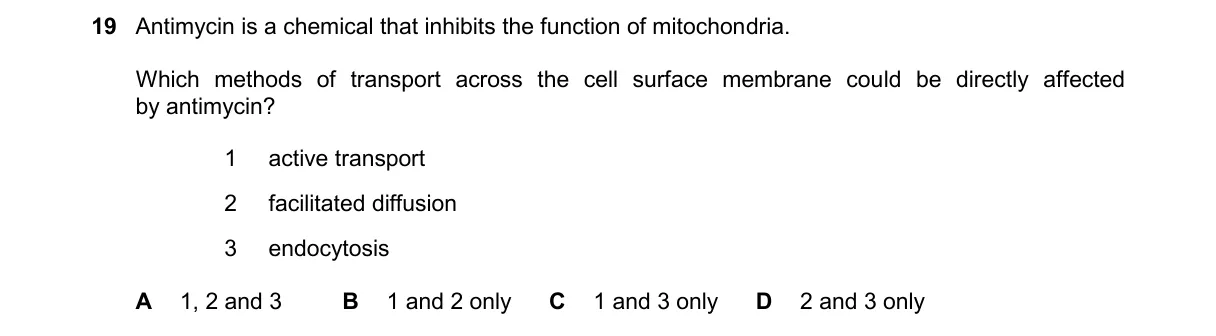
Answer choices
- A1, 2 and 3
- B1 and 2 only
- C1 and 3 only
- D2 and 3 only
Explanation
Antimycin disrupts ATP production, affecting energy-dependent membrane transport
Steps:
- Antimycin blocks the electron transport chain in mitochondria, halting ATP synthesis.
- Active transport uses ATP to move substances against concentration gradients, so it requires mitochondrial function.
- Facilitated diffusion relies on carrier proteins without energy input, remaining unaffected.
- Endocytosis consumes ATP for membrane invagination and vesicle formation, depending on energy from mitochondria.
Why C is correct:
- Active transport and endocytosis both require ATP (per cellular energy definitions), which antimycin depletes by inhibiting oxidative phosphorylation.
Why the others are wrong:
- A includes facilitated diffusion, a passive process independent of ATP.
- B omits endocytosis, an ATP-dependent bulk transport mechanism.
- D excludes active transport, which directly uses ATP for ion/molecule pumping.
Final answer: C
Topic: Movement into and out of cells
Practice more A Levels Biology (9700) questions on mMCQ.me