A Levels Biology (9700)•9700/13/M/J/25
A Levels Biology (9700) — 9700/13/M/J/25, Question 18
Descriptions of three biological molecules found in cell surface membranes are given. • X is a molecule comprised of carbon, hydrogen and oxygen, with a non-polar region • Y is a molecule that has a hydrophilic end and that forms hydrogen bonds with water outside the membrane, and a hydrophobic region that is located within the cell membrane. • Z is a molecule with one and two hydrophobic extensions that are positioned within the membrane. Which row correctly identifies a carrier protein and a glycolipid?
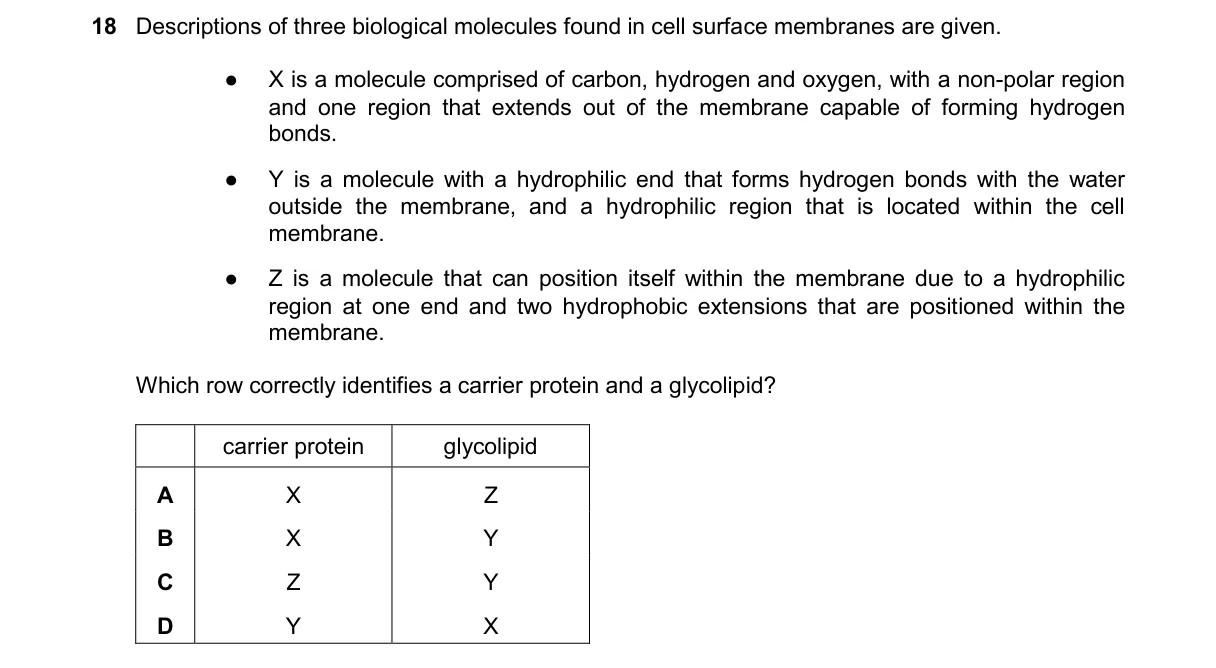
Answer choices
- Acarrier protein: X, glycolipid: Z
- Bcarrier protein: X, glycolipid: Y
- Ccarrier protein: Y, glycolipid: X
- Dcarrier protein: Z, glycolipid: Y
Explanation
Matching membrane molecule descriptions to carrier protein and glycolipid
Steps:
- X describes a non-polar lipid like cholesterol (C, H, O only, no hydrophilic part).
- Y describes an amphipathic lipid with a hydrophilic head (forms H-bonds with external water) and hydrophobic region inside, matching glycolipid structure.
- Z describes an integral protein with 1-2 hydrophobic transmembrane extensions, matching carrier protein function.
- Option D pairs Z as carrier protein and Y as glycolipid, aligning with definitions.
Why D is correct:
- Carrier proteins are transmembrane proteins with hydrophobic regions spanning the bilayer (Z); glycolipids are lipids with hydrophilic sugar heads extracellularly and hydrophobic tails embedded (Y).
Why the others are wrong:
- A: X is a non-polar lipid, not a protein.
- B: X is a non-polar lipid, not a protein.
- C: Y is a lipid, not a protein; X lacks a hydrophilic head.
Final answer: D
Topic: Fluid mosaic membranes
Practice more A Levels Biology (9700) questions on mMCQ.me