A Levels Biology (9700)•9700/13/M/J/25
A Levels Biology (9700) — 9700/13/M/J/25, Question 17
The diagram shows part of a eukaryotic cell surface membrane. Which components act as antigens in cell membranes?
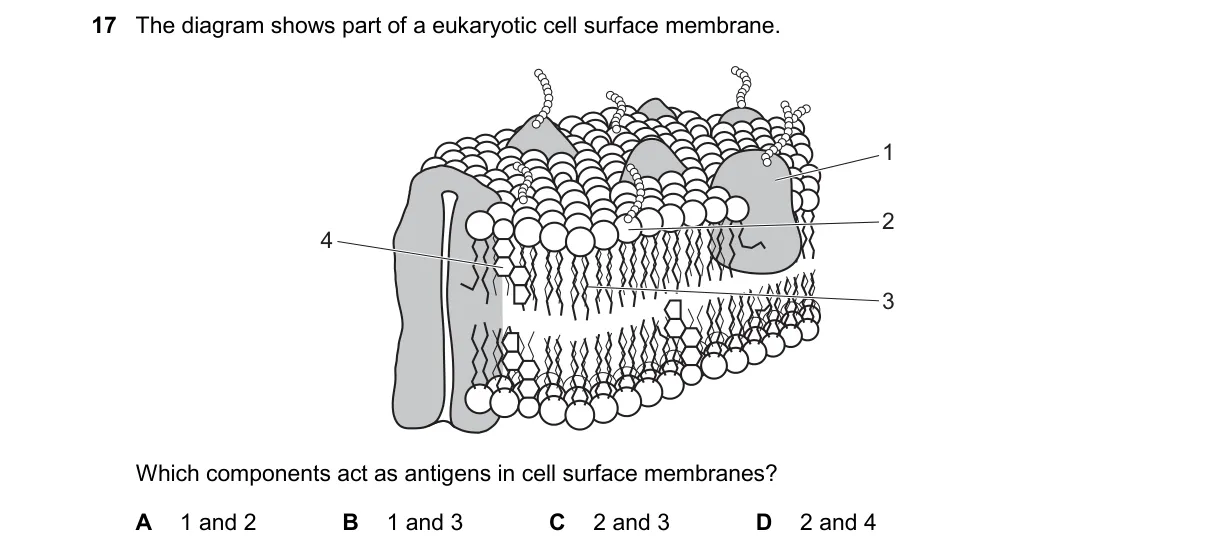
Answer choices
- A1 and 2
- B1 and 3
- C2 and 3
- D2 and 4
Explanation
Antigens in eukaryotic cell membranes are specific surface molecules
Steps:
- Recall that cell membrane antigens are typically glycoproteins and glycolipids that trigger immune responses.
- Identify components in the diagram: assume 1 is glycoprotein, 2 is glycolipid, 3 is phospholipid, 4 is cholesterol based on standard membrane models.
- Match antigens to surface-exposed parts that can be recognized by antibodies.
- Select pairs where both are antigenic: 1 and 2 fit as they are carbohydrate-bearing molecules.
Why A is correct:
- Antigens are defined as molecules like glycoproteins (1) and glycolipids (2) that protrude from the membrane and elicit immune recognition.
Why the others are wrong:
- B: 3 is phospholipid, which forms the membrane backbone but does not act as an antigen.
- C: 2 is antigenic, but 3 (phospholipid) is not.
- D: 4 is cholesterol, a structural lipid without antigenic properties.
Final answer: A
Topic: Fluid mosaic membranes
Practice more A Levels Biology (9700) questions on mMCQ.me