A Levels Biology (9700)•9700/13/M/J/25
A Levels Biology (9700) — 9700/13/M/J/25, Question 16
The activity of enzyme can be affected by a competitive inhibitor. Which of the following is correct for the effect of a competitive inhibitor on the value of Km, and the reason for this?
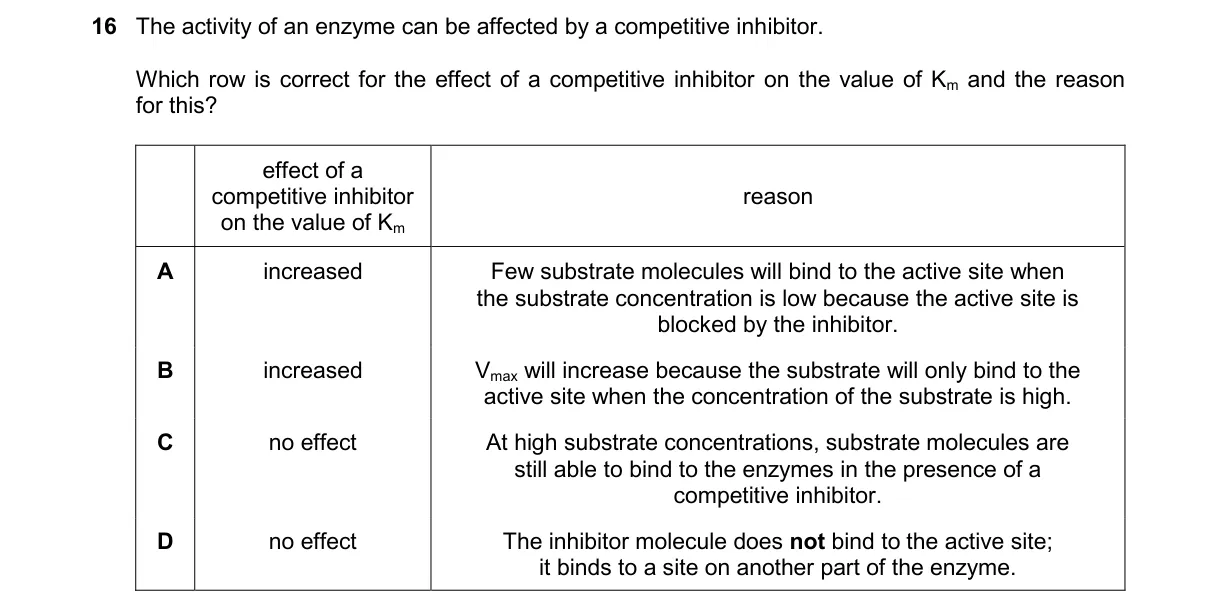
Answer choices
- Aincreased. Few substrate molecules will be to the active site when blocked by the inhibitor.
- Bincreased. Vmax will be blocked by the inhibitor. The substrate will only bind to the active site when the concentrations of substrate are high.
- Cno effect. At high substrate concentrations, substrate molecules are still able to bind to the active site.
- Dno effect. The inhibitor molecules does not bind to the active site; it binds to another part of the enzyme.
Explanation
Competitive inhibitors raise Km by competing for the active site
Steps:
- Competitive inhibitors bind reversibly to the enzyme's active site, directly competing with substrate molecules.
- This competition reduces the enzyme's apparent affinity for the substrate at lower concentrations.
- Km, defined as the substrate concentration yielding half of Vmax, increases because higher substrate levels are needed to outcompete the inhibitor.
- Vmax remains unchanged, as sufficient substrate can fully saturate the enzyme.
Why A is correct:
- Km increases per Michaelis-Menten kinetics, as the inhibitor effectively lowers substrate binding affinity by occupying the active site.
Why the others are wrong:
- B: Vmax is unaffected; competitive inhibition only alters Km, not maximum velocity.
- C: Km is increased, even though high substrate overcomes inhibition to reach Vmax.
- D: Competitive inhibitors bind specifically to the active site, not elsewhere.
Final answer: A
Topic: Factors that affect enzyme action
Practice more A Levels Biology (9700) questions on mMCQ.me