A Levels Biology (9700)•9700/13/M/J/25
A Levels Biology (9700) — 9700/13/M/J/25, Question 10
The diagrams show how some polymers of glucose can be classified. Which row correctly identifies P, Q and R?
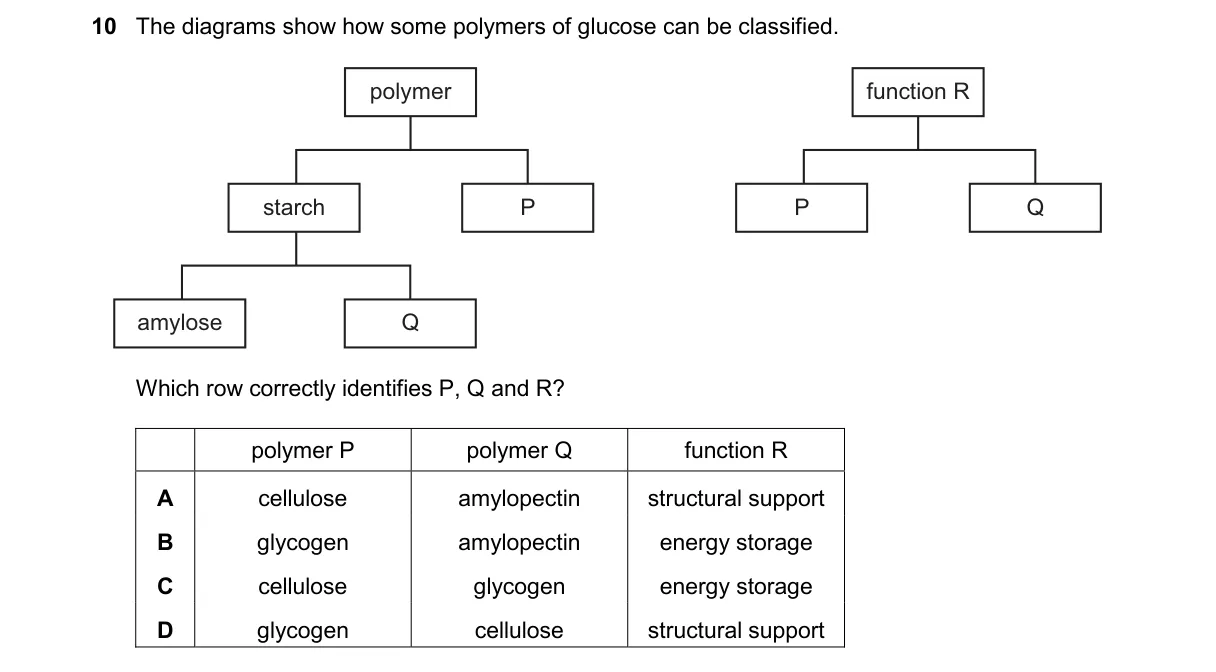
Answer choices
- Apolymer P: cellulose; polymer Q: amylopectin; function R: structural support
- Bpolymer P: cellulose; polymer Q: glycogen; function R: energy storage
- Cpolymer P: glycogen; polymer Q: cellulose; function R: energy storage
- Dpolymer P: glycogen; polymer Q: cellulose; function R: structural support
Explanation
Classifying glucose polymers by structure and function
Steps:
- Examine diagram P: linear, unbranched chains indicate cellulose for plant cell walls.
- Examine diagram Q: highly branched structure indicates glycogen for animal energy storage.
- Examine label R: describes compact, mobilizable form for quick glucose release, matching energy storage.
- Match to options: only B aligns P as cellulose, Q as glycogen, and R as energy storage.
Why B is correct:
- Glycogen's branched α-1,6 linkages allow rapid enzymatic breakdown for energy, unlike linear cellulose's β-1,4 bonds for rigidity.
Why the others are wrong:
- A: Amylopectin is plant starch (branched), not animal glycogen; R mismatches cellulose's role.
- C: Swaps P and Q; glycogen is branched (not linear like cellulose), and R fits glycogen, not cellulose.
- D: Swaps P and Q; R's storage function suits glycogen, not structural cellulose.
Final answer: B
Topic: Carbohydrates and lipids
Practice more A Levels Biology (9700) questions on mMCQ.me