A Levels Biology (9700)•9700/12/M/J/25
A Levels Biology (9700) — 9700/12/M/J/25, Question 9
Amylose, amylopectin and glycogen are all polysaccharides. Enzyme X removes one maltose molecule at a time from the ends of a polysaccharide molecule by hydrolysis of α-1,4 glycosidic bonds. Which row shows how completely each of these molecules will be hydrolysed by enzyme X? (Assume that each polysaccharide is composed of the same number of monomers before hydrolysis begins.)
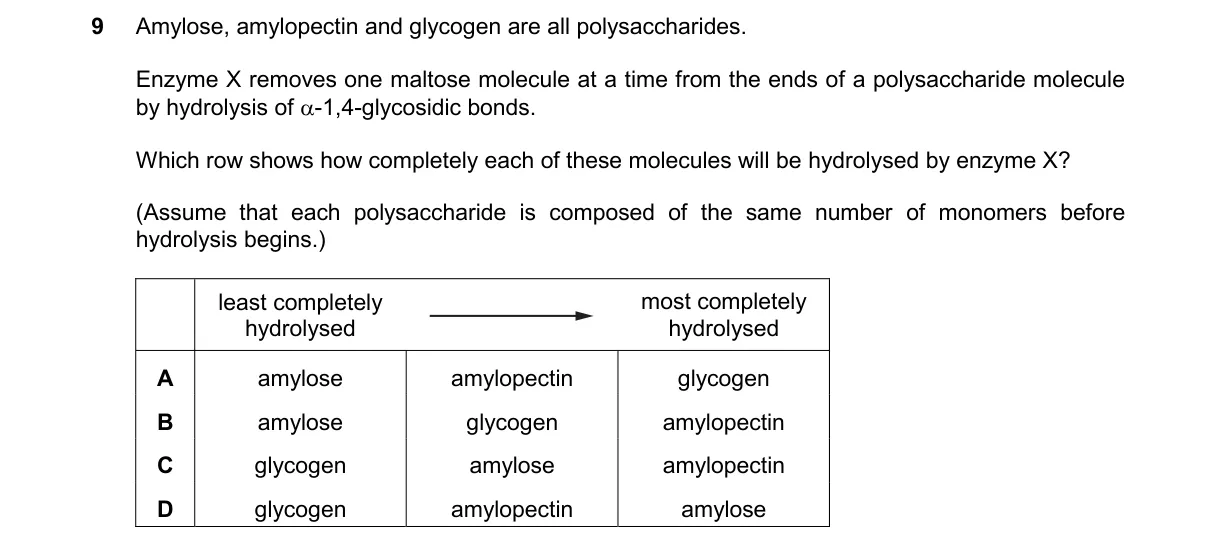
Answer choices
- Aamylose, amylopectin, glycogen
- Bglycogen, amylopectin, amylase
- Cglycogen, amylase, amylopectin
- Dglycogen, amylopectin, amylase
Explanation
Branching inversely affects hydrolysis completeness by limiting access to α-1,4 bonds Steps:
- Enzyme X hydrolyzes α-1,4 glycosidic bonds from non-reducing ends, releasing maltose units until reaching branch points.
- Amylose has no branches (all α-1,4 links), allowing full access and complete hydrolysis.
- Amylopectin branches every ~24-30 monomers via α-1,6 bonds, leaving some limit dextrin but more hydrolysis than glycogen.
- Glycogen branches every ~8-12 monomers, creating shorter linear segments and larger limit dextrin, so least hydrolysis. Why D is correct:
- D orders polysaccharides from least to most completely hydrolysed (glycogen most branched/lowest yield, amylopectin intermediate, amylose unbranched/full yield), matching the inverse relation to branching frequency. Why the others are wrong:
- A: Reverses the order, starting with most complete (amylose) instead of least.
- B: Places amylopectin before amylose, ignoring amylose's higher completeness due to no branches.
- C: Places amylose (most complete) before amylopectin (less complete), disrupting the increasing order.
Final answer: D
Topic: Carbohydrates and lipids
Practice more A Levels Biology (9700) questions on mMCQ.me