A Levels Biology (9700)•9700/12/M/J/25
A Levels Biology (9700) — 9700/12/M/J/25, Question 37
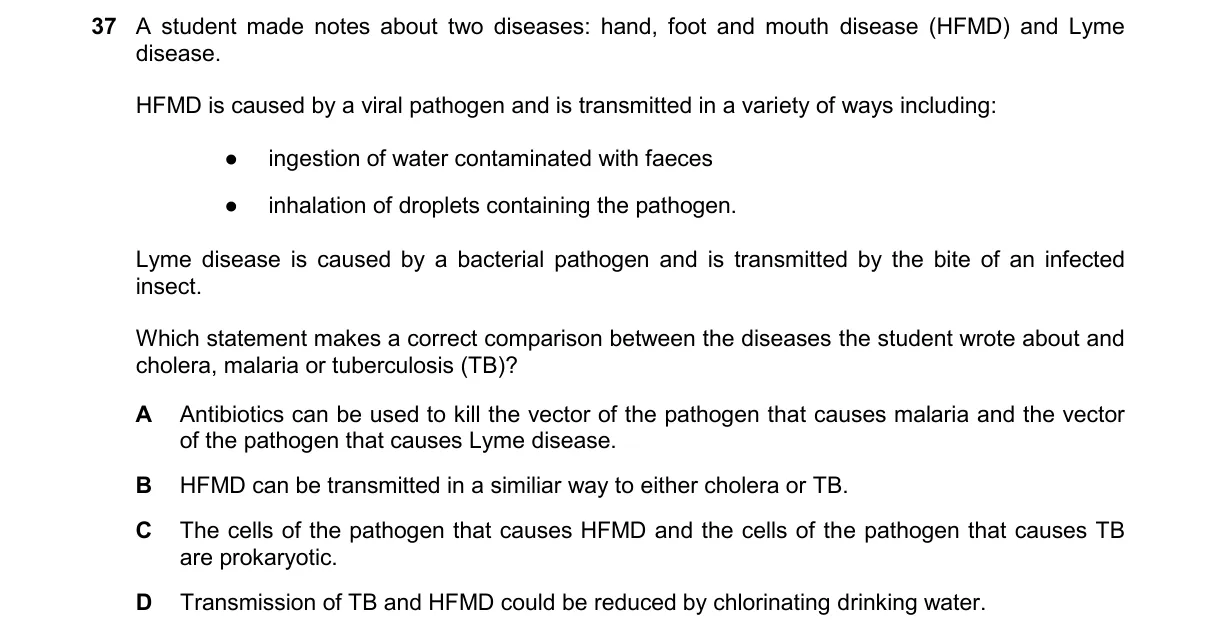
A student made notes about two diseases: hand, foot and mouth disease (HFMD) and Lyme disease. HFMD is caused by a viral pathogen and is transmitted in a variety of ways including: ingestion of water contaminated with faeces. Ingestion of droplets containing the pathogen. Lyme disease is caused by a bacterial pathogen and is transmitted by the bite of an infected tick. Which statement about the diseases the student wrote about and which, malaria or tuberculosis (TB) is correct?
Answer choices
- AAntibiotics can be used to kill the pathogen that causes Lyme disease.
- BHFMD can be transmitted in a similar way to cholera, malaria or tuberculosis (TB).
- CThe cells of the pathogen that causes HFMD or the cells of the pathogen that causes TB are prokaryotic.
- DTransmission of TB and HFMD could be reduced by chlorinating drinking water.
Explanation
Transmission similarities of HFMD to cholera and TB
Steps:
- Identify HFMD transmissions from notes: fecal contamination in water (like cholera) and pathogen droplets (like TB).
- Recall cholera spreads via fecal-oral route in contaminated water; TB via airborne droplets.
- Confirm HFMD matches cholera in water ingestion and TB in droplet ingestion.
- Rule out malaria, which uses mosquito bites, unlike HFMD methods.
Why B is correct:
- HFMD shares fecal-oral transmission with cholera (contaminated water) and droplet transmission with TB, per standard epidemiological definitions of these routes.
Why the others are wrong:
- A: Statement is factually true for bacterial Lyme but ignores required comparison to malaria or TB.
- C: HFMD pathogen (virus) lacks cells and is not prokaryotic; only TB's bacterial cells are.
- D: Chlorination targets waterborne HFMD but not airborne TB transmission.
Final answer: B
Topic: Infectious diseases
Practice more A Levels Biology (9700) questions on mMCQ.me