A Levels Biology (9700)•9700/12/M/J/25
A Levels Biology (9700) — 9700/12/M/J/25, Question 24
Sometimes hydrogen bonds form temporarily between the bases of two strands of RNA. How many hydrogen bonds form when guanine and uracil each bind to their complementary base?
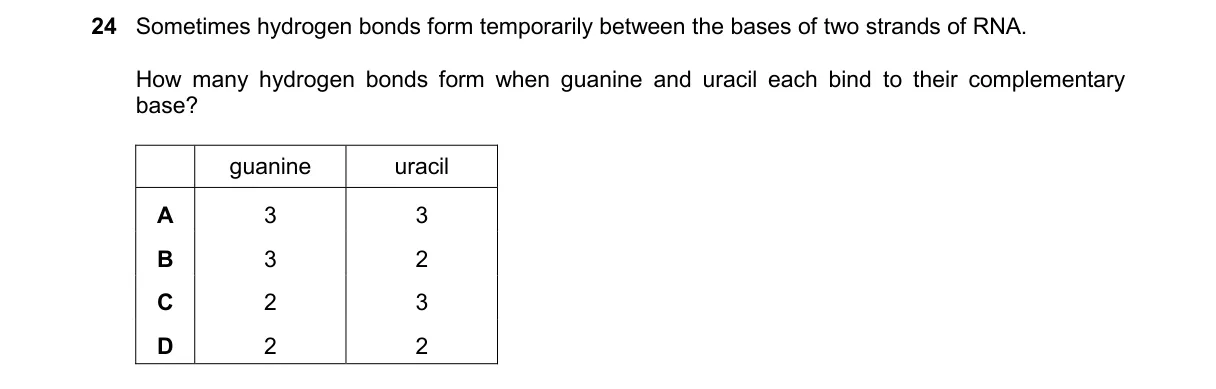
Answer choices
- A3 3
- BOption B
- C2 3
- D2 2
Explanation
RNA Base Pairing Hydrogen Bonds
Steps:
- Identify complementary bases: guanine pairs with cytosine; uracil pairs with adenine.
- Recall hydrogen bond counts: G-C forms 3 bonds; A-U forms 2 bonds.
- Apply to guanine: binds to cytosine with 3 hydrogen bonds.
- Apply to uracil: binds to adenine with 2 hydrogen bonds.
Why B is correct:
- In RNA, G-C pairing follows Watson-Crick rules with 3 hydrogen bonds, while A-U pairing has 2, matching the 3 2 configuration.
Why the others are wrong:
- A (3 3): Incorrectly assigns 3 bonds to uracil-adenine, which has only 2.
- C (2 3): Reverses the pairs, giving guanine only 2 bonds instead of 3.
- D (2 2): Understates guanine-cytosine bonds, which are 3, not 2.
Final answer: B
Topic: Structure of nucleic acids and replication of DNA
Practice more A Levels Biology (9700) questions on mMCQ.me