A Levels Biology (9700)•9700/12/M/J/25
A Levels Biology (9700) — 9700/12/M/J/25, Question 20
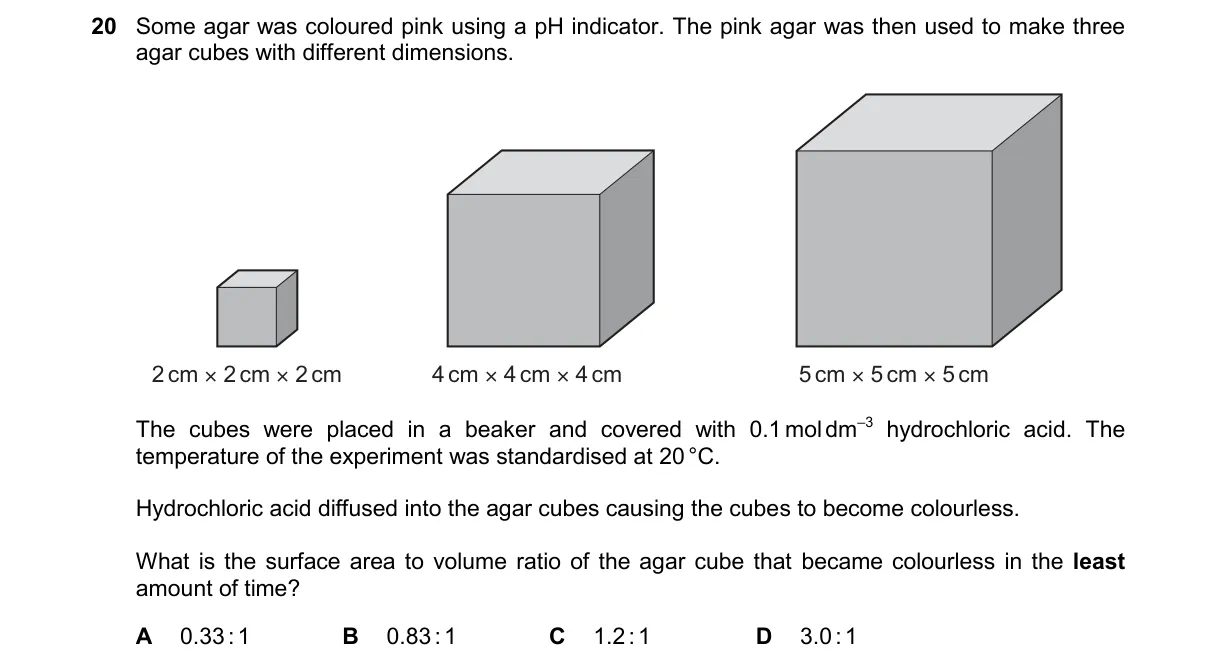
Some agar was coloured pink using pH indicator. The pink agar was then used to make three agar cubes with different dimensions. 2cm x 2cm x 2cm 4cm x 4cm x 4cm 5cm x 5cm x 5cm. The cubes were placed in a beaker and covered with 0.1 mol dm^{-3} hydrochloric acid. The temperature of the experiment was standardised at 20°C. Hydrochloric acid diffused into the agar cubes causing the cubes to become colourless. What is the surface area to volume ratio of the agar cube that becomes colourless in the least amount of time?
Answer choices
- A0.3-1
- B0.8-1
- C1:2-1
- D3.0-1
Explanation
Surface Area to Volume Ratio Determines Diffusion Speed
Steps:
- Surface area (SA) of cube = 6 × side²; volume (V) = side³; ratio = SA/V = 6/side.
- For 2 cm cube: 6/2 = 3 (or 3:1).
- For 4 cm cube: 6/4 = 1.5 (or 3:2).
- For 5 cm cube: 6/5 = 1.2 (or 6:5).
- Highest ratio (2 cm cube) allows fastest acid diffusion to center, turning colorless quickest.
Why D is correct:
- 3.0:1 matches the 2 cm cube's ratio, where high SA:V enables rapid diffusion per Fick's law (rate proportional to surface area and concentration gradient).
Why the others are wrong:
- A: 0.3:1 is far too low, matching a ~20 cm cube with slow diffusion.
- B: 0.8:1 is low, matching a ~7.5 cm cube, slower than smaller cubes.
- C: 1:2 (0.5:1) is low, matching a 12 cm cube, even slower.
Final answer: D
Topic: Movement into and out of cells
Practice more A Levels Biology (9700) questions on mMCQ.me