A Levels Biology (9700)•9700/12/M/J/25
A Levels Biology (9700) — 9700/12/M/J/25, Question 17
Cell membranes become less fluid as the temperature decreases. How do bacteria and yeast maintain the fluidity of their cell membranes when the temperature decreases? 1 They increase the numbers of unsaturated fatty acids in their phospholipid molecules. 2 They increase the numbers of saturated fatty acids in their phospholipid molecules. 3 They increase the numbers of cholesterol molecules in their cell membranes.
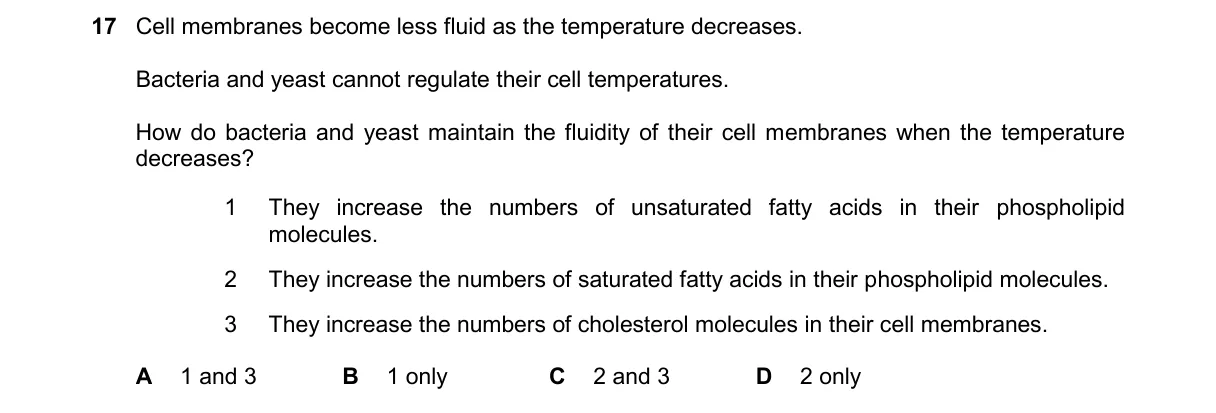
Answer choices
- A1 and 3
- B1 only
- C2 and 3
- D2 only
Explanation
Adjusting Membrane Lipids for Fluidity
Steps:
- Cell membranes lose fluidity in cold due to closer phospholipid packing.
- Unsaturated fatty acids have double bonds creating kinks that disrupt packing and maintain fluidity.
- Increasing unsaturated fatty acids counters cold-induced rigidity.
- Cholesterol molecules insert between phospholipids, buffering against excessive rigidity in low temperatures.
Why A is correct:
- Unsaturated fatty acids lower the membrane's gel-to-liquid transition temperature via kinks from double bonds (definition of unsaturation effect); cholesterol stabilizes fluidity by preventing tight packing (fluid mosaic model principle).
Why the others are wrong:
- B: Omits cholesterol's role in preventing cold-induced rigidity.
- C: Saturated fatty acids lack kinks, increasing rigidity and worsening fluidity loss.
- D: Saturated fatty acids promote tighter packing, reducing fluidity further.
Final answer: A
Topic: Fluid mosaic membranes
Practice more A Levels Biology (9700) questions on mMCQ.me