A Levels Biology (9700)•9700/12/M/J/25
A Levels Biology (9700) — 9700/12/M/J/25, Question 11
Which bonds are found in the primary, secondary and tertiary structures of a protein molecule?
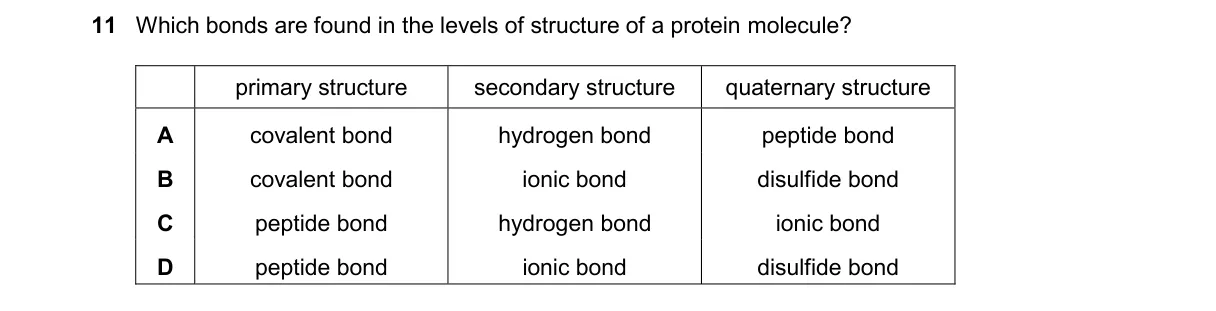
Answer choices
- Aprimary structure: covalent bond; secondary structure: hydrogen bond; tertiary structure: peptide bond
- Bprimary structure: peptide bond; secondary structure: ionic bond; tertiary structure: disulfide bond
- Cprimary structure: peptide bond; secondary structure: hydrogen bond; tertiary structure: ionic bond
- Dprimary structure: peptide bond; secondary structure: ionic bond; tertiary structure: disulfide bond
Explanation
Bonds in Protein Structures
Steps:
- Primary structure consists of amino acids linked by peptide bonds, forming the polypeptide chain.
- Secondary structure features local folding, such as alpha helices and beta sheets, stabilized by hydrogen bonds between backbone atoms.
- Tertiary structure involves the overall 3D folding of the chain, maintained by interactions like ionic bonds between charged side chains.
- Compare options: only C correctly matches peptide bonds to primary, hydrogen bonds to secondary, and ionic bonds to tertiary.
Why C is correct:
- Peptide bonds covalently link amino acids in the primary sequence; hydrogen bonds stabilize secondary motifs per the definition of alpha helices and beta sheets; ionic bonds form salt bridges that lock tertiary structure.
Why the others are wrong:
- A: Peptide bonds occur in primary structure, not tertiary.
- B: Ionic bonds stabilize tertiary folding, not secondary.
- D: Ionic bonds are for tertiary, while secondary uses hydrogen bonds.
Final answer: C
Topic: Proteins
Practice more A Levels Biology (9700) questions on mMCQ.me