A Levels Biology (9700)•9700/12/M/J/25
A Levels Biology (9700) — 9700/12/M/J/25, Question 1
Which row shows possible uses of an eyepiece graticule?
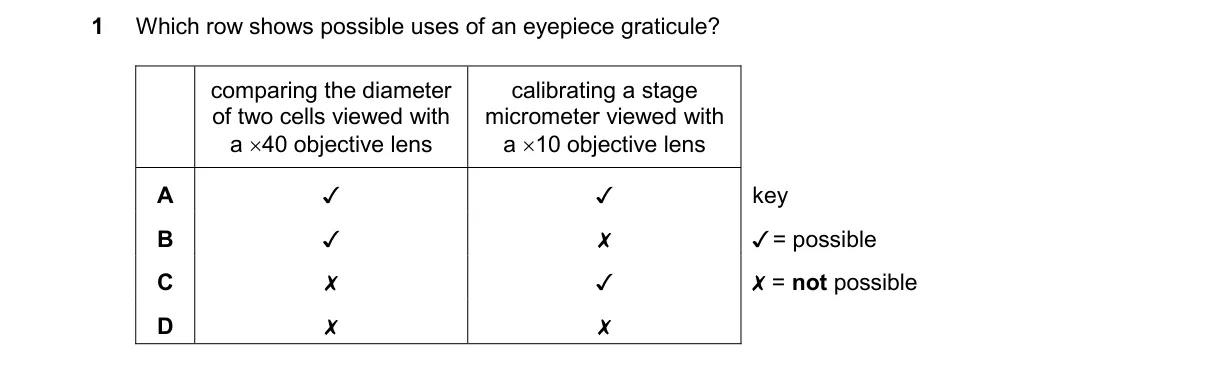
Answer choices
- A✓ comparing the diameter of two cells viewed with a ×10 objective lens, ✗ calibrating a stage micrometer viewed with a ×10 objective lens
- Bx comparing the diameter of two cells viewed with a ×10 objective lens, ✓ calibrating a stage micrometer viewed with a ×10 objective lens
- Cx comparing the diameter of two cells viewed with a ×10 objective lens, x calibrating a stage micrometer viewed with a ×10 objective lens
- Dx comparing the diameter of two cells viewed with a ×10 objective lens, x calibrating a stage micrometer viewed with a ×10 objective lens
Explanation
Eyepiece graticule calibrates for actual measurements but doesn't enable uncalibrated actual size comparisons Steps:
- Identify eyepiece graticule as a scale in the eyepiece for viewing specimen images under microscope objectives.
- Note it measures in arbitrary divisions, requiring calibration for real units like micrometers.
- Use stage micrometer (known scale) under same objective (e.g., ×10) to match divisions and calibrate graticule.
- Conclude: calibration with stage micrometer is direct use (✓); comparing actual cell diameters needs calibration first, so not possible without it (x).
Why B is correct:
- Eyepiece graticule definition: tool calibrated by aligning its divisions with stage micrometer's known 10 μm or 100 μm intervals under specific objective for accurate scaling.
Why the others are wrong:
- A: Wrongly allows uncalibrated cell comparison (needs actual sizes) and rejects valid calibration step.
- C: Falsely rejects both; calibration is a core use.
- D: Identical to C, so doubly rejects valid calibration.
Final answer: B
Topic: The microscope in cell studies
Practice more A Levels Biology (9700) questions on mMCQ.me