A Levels Biology (9700)•9700/11/M/J/25
A Levels Biology (9700) — 9700/11/M/J/25, Question 7
The iodine test and the Benedict's test were carried out on samples of starch solution. Amylase was added to another sample of the starch solution and incubated for 10 minutes. The Benedict's test was then carried out on this sample. What were the results of the tests?
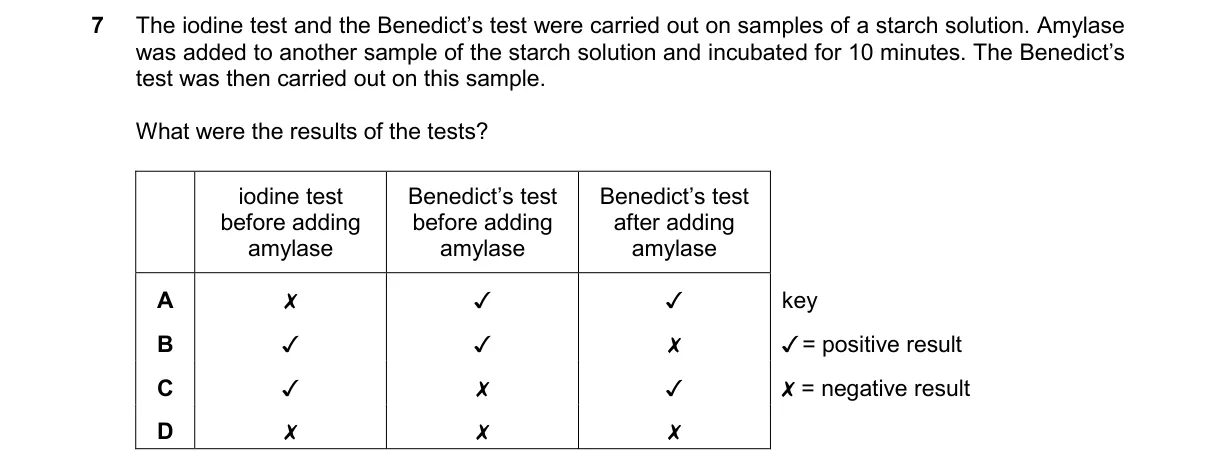
Answer choices
- Ax ✓ ✓
- B✓ x ✓
- C✓ x x
- Dx x x
Explanation
Incomplete starch digestion in short incubation Steps:
- Iodine test detects starch; original starch solution turns blue-black (positive).
- Benedict's test detects reducing sugars; starch is non-reducing, so original sample is negative.
- Amylase breaks starch into maltose (reducing sugar), but 10-minute incubation yields insufficient maltose for positive Benedict's.
- Thus, treated sample's Benedict's test remains negative.
Why C is correct:
- C (✓ x x) reflects iodine positive for starch, both Benedict's negative due to no initial sugars and incomplete hydrolysis per enzyme kinetics (rate limited by time).
Why the others are wrong:
- A: Falsely shows negative iodine and positive original Benedict's, ignoring starch properties.
- B: Erroneously assumes 10 minutes produces detectable reducing sugars.
- D: Wrongly indicates negative iodine for starch-present solution.
Final answer: C
Topic: Mode of action of enzymes
Practice more A Levels Biology (9700) questions on mMCQ.me