A Levels Biology (9700)•9700/11/M/J/25
A Levels Biology (9700) — 9700/11/M/J/25, Question 34
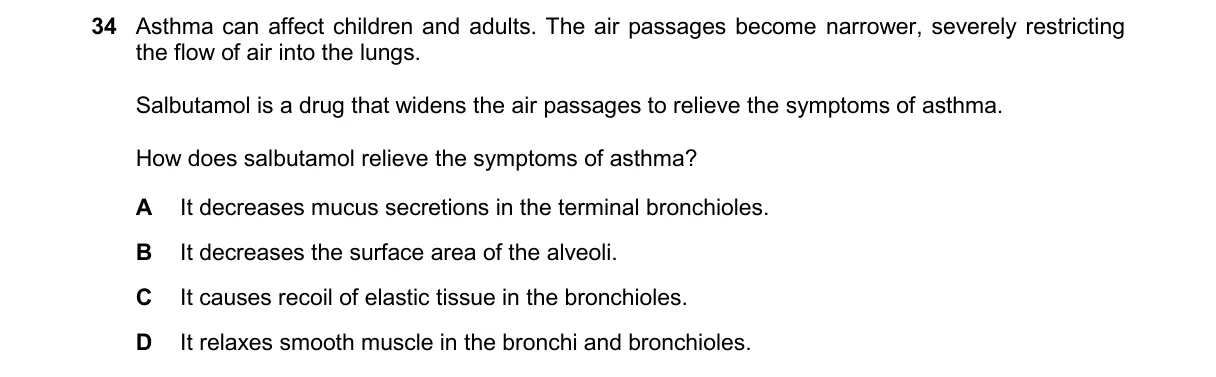
Asthma can affect children and adults. The air passages become narrower, severely restricting the flow of air into the lungs. Salbutamol is a drug that widens the air passages to relieve the symptoms of asthma. How does salbutamol relieve the symptoms of asthma?
Answer choices
- AIt decreases mucus secretion in the alveoli.
- BIt decreases surface area of the alveoli.
- CIt causes recoil of elastic tissue in the bronchioles.
- DIt relaxes smooth muscle in the bronchi and bronchioles.
Explanation
Salbutamol relaxes bronchial smooth muscle to widen airways
Steps:
- Asthma narrows air passages due to bronchoconstriction from smooth muscle tightening.
- Salbutamol is a beta-2 agonist that targets receptors in bronchial smooth muscle.
- It stimulates these receptors to increase cyclic AMP, leading to muscle relaxation.
- Relaxed muscles dilate bronchi and bronchioles, improving airflow to lungs.
Why D is correct:
- Salbutamol acts as a bronchodilator by binding to beta-2 adrenergic receptors, relaxing smooth muscle via the second messenger cyclic AMP, as defined in pharmacology.
Why the others are wrong:
- A: Salbutamol does not affect mucus secretion; it targets muscle tone, not glandular activity in alveoli.
- B: Alveolar surface area is unchanged; salbutamol acts on airways, not lung parenchyma.
- C: Elastic recoil aids expiration but is not salbutamol's action; it prevents constriction, not recoil.
Final answer: D
Topic: The gas exchange system
Practice more A Levels Biology (9700) questions on mMCQ.me