A Levels Biology (9700)•9700/11/M/J/25
A Levels Biology (9700) — 9700/11/M/J/25, Question 30
A mutation in one of the genes that codes for hemoglobin changes the affinity of hemoglobin for oxygen. This mutation lowers the partial pressure of oxygen at which hemoglobin is 50% saturated with oxygen. Which row shows the effect of the mutation on the affinity of hemoglobin for oxygen and the change in position of the oxygen dissociation curve for hemoglobin?
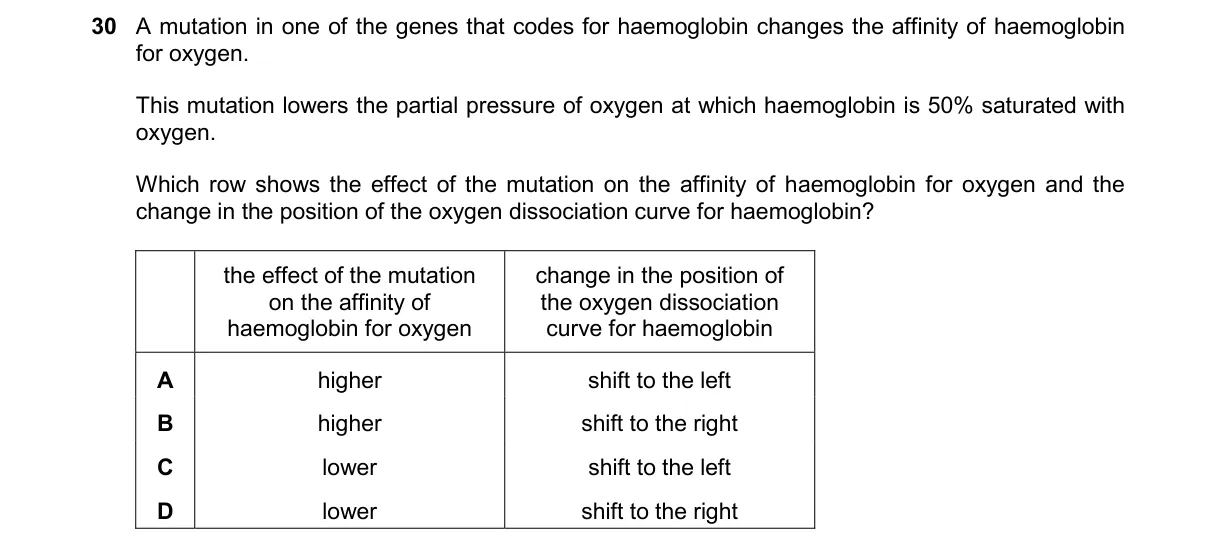
Answer choices
- Ahigher shift to the right
- Bhigher shift to the left
- Clower shift to the left
- Dlower shift to the right
Explanation
Lower P50 means higher oxygen affinity and leftward curve shift Steps:
- P50 is the partial pressure (PO2) where hemoglobin is 50% saturated with oxygen.
- Lowering P50 indicates hemoglobin saturates at lower PO2, meaning higher affinity for oxygen.
- Higher affinity causes the oxygen dissociation curve to shift left, as hemoglobin binds oxygen more tightly.
- Thus, the mutation increases affinity and shifts the curve left.
Why B is correct:
- Higher affinity corresponds to a left shift per standard oxygen-hemoglobin dissociation curve principles, where decreased P50 reflects tighter O2 binding.
Why the others are wrong:
- A: Higher affinity pairs with left (not right) shift; right shift indicates lower affinity.
- C: Mutation raises (not lowers) affinity, so lower affinity is incorrect.
- D: Lower affinity would raise P50 and shift right, opposite the mutation's effect.
Final answer: B
Topic: Transport of oxygen and carbon dioxide
Practice more A Levels Biology (9700) questions on mMCQ.me