A Levels Biology (9700)•9700/11/M/J/25
A Levels Biology (9700) — 9700/11/M/J/25, Question 22
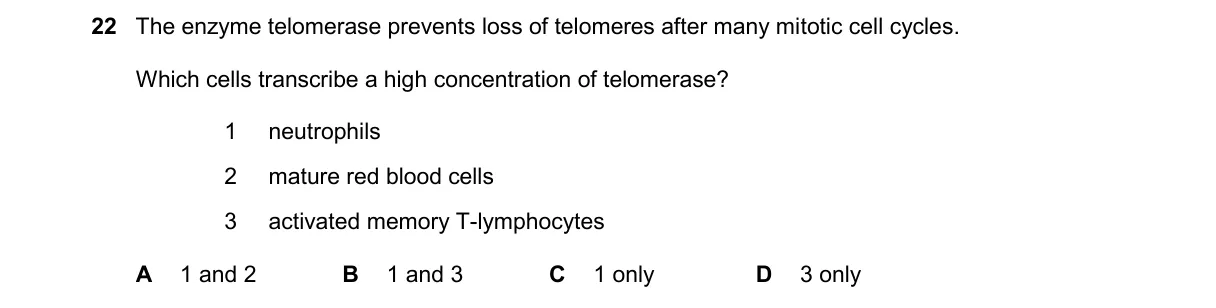
The telomerase prevents loss of telomeres after many mitotic cell cycles. Which cells have a high concentration of telomerase? 1 neutrophils 2 mature red blood cells 3 mature T-lymphocytes
Answer choices
- A1 and 2
- B1 and 3
- C1 only
- D3 only
Explanation
Telomerase in Proliferating Lymphocytes
Steps:
- Telomerase enzyme adds telomere repeats to chromosome ends, enabling sustained cell division.
- Identify cell types: Neutrophils are terminally differentiated granulocytes with limited lifespan.
- Mature red blood cells are anucleate and incapable of any replication.
- Mature T-lymphocytes undergo activation and clonal expansion through multiple mitoses.
Why D is correct:
- Activated T-lymphocytes express high telomerase levels to counteract telomere erosion during immune response proliferation, per telomere biology principles.
Why the others are wrong:
- A: Neutrophils and red blood cells do not divide post-maturation, lacking telomerase.
- B: Neutrophils are post-mitotic and do not require telomerase for division.
- C: Neutrophils have low telomerase as they do not proliferate.
Final answer: D
Topic: Replication and division of nuclei and cells
Practice more A Levels Biology (9700) questions on mMCQ.me