A Levels Biology (9700)•9700/11/M/J/25
A Levels Biology (9700) — 9700/11/M/J/25, Question 18
A student immersed a plant in solution S. For the next 30 minutes, the student used a microscope to observe the cells in the plant. In many cells, the cytoplasm had shrunk and no longer pushed up against the cell wall. During this time, a clear space appeared between the cell wall and the cytoplasm of many cells. Which statements are correct conclusions from the observations? 1 the water potential in solution S was more negative than the water potential in the cytoplasm 2 without a cell wall to provide the support, it is likely that many of the cells would have burst 3 the clear space between the cell wall and cytoplasm of many cells was
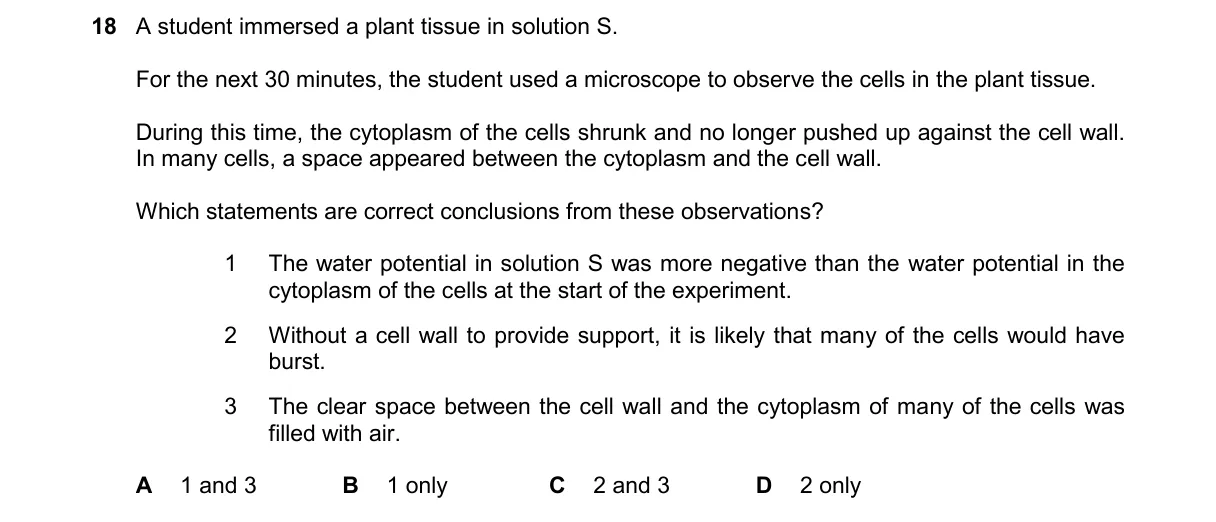
Answer choices
- A1 and 3
- B1 only
- C2 and 3
- D2 only
Explanation
Plasmolysis in hypertonic solution
Steps:
- Observe plasmolysis: cytoplasm shrinks from cell wall, indicating water loss from cells.
- Water exits cells when external solution has lower (more negative) water potential than cytoplasm, causing shrinkage.
- Statement 1 correct: solution S is hypertonic, with more negative ψ than cytoplasm.
- Statement 2 incorrect: cell wall prevents bursting in hypotonic conditions (turgor), not relevant here.
- Statement 3 incomplete but describes plasmolysis gap, not a conclusion about cause.
Why B is correct:
- Plasmolysis confirms hypertonic solution (more negative ψ outside), validating only statement 1 per osmosis principles.
Why the others are wrong:
- A includes 3, but 3 is observational, not a conclusion on cause.
- C includes 2, but cell wall supports against bursting in hypotonic, not hypertonic conditions.
- D includes only 2, which misapplies cell wall role.
Final answer: B
Topic: Movement into and out of cells
Practice more A Levels Biology (9700) questions on mMCQ.me