A Levels Biology (9700)•9700/11/M/J/25
A Levels Biology (9700) — 9700/11/M/J/25, Question 17
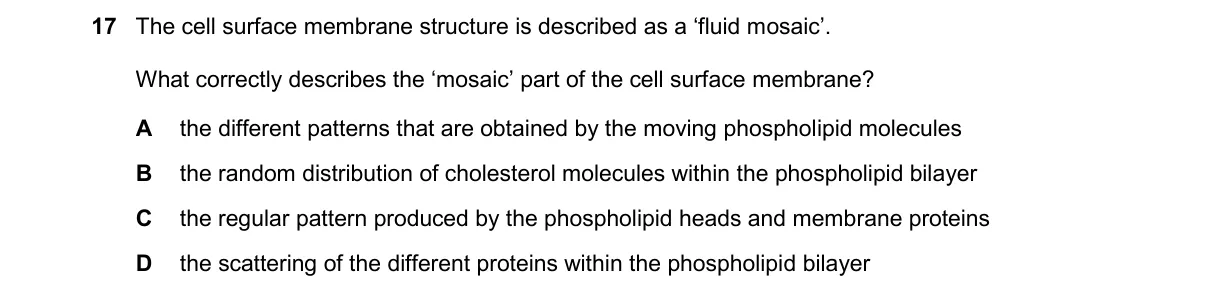
The cell surface membrane structure described as a fluid mosaic:
Answer choices
- Athe different patterns that are made by the moving phospholipid molecules
- Bthe random distribution of cholesterol molecules within phospholipid bilayer
- Cthe regular pattern of cholesterol molecules within phospholipid bilayer
- Dthe scattering of the different proteins within the phospholipid bilayer
Explanation
Fluid Mosaic Model of Cell Membranes
Steps:
- Recall the fluid mosaic model: a dynamic structure with a fluid phospholipid bilayer.
- Identify key components: phospholipids provide fluidity; proteins are embedded and scattered.
- Evaluate choices: mosaic refers to the patchwork-like distribution of proteins, not lipids or cholesterol patterns.
- Confirm: the term "mosaic" specifically describes protein scattering in the bilayer.
Why D is correct:
- The fluid mosaic model, proposed by Singer and Nicolson, defines the membrane as a fluid lipid bilayer with proteins scattered irregularly like mosaic tiles.
Why the others are wrong:
- A: Phospholipid movement creates fluidity, not distinct patterns.
- B: Cholesterol is randomly distributed for stability, but doesn't define the mosaic aspect.
- C: Cholesterol lacks a regular pattern; it's interspersed without fixed arrangement.
Final answer: D
Topic: Fluid mosaic membranes
Practice more A Levels Biology (9700) questions on mMCQ.me