A Levels Biology (9700)•9700/11/M/J/25
A Levels Biology (9700) — 9700/11/M/J/25, Question 14
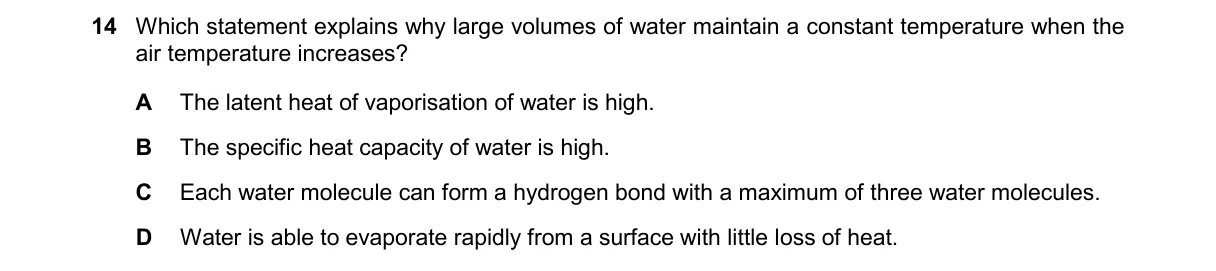
Which statement explains why large volumes of water maintain a constant temperature when the temperature increases?
Answer choices
- AThe latent heat of vaporisation of water is high.
- BEach water molecule can form a hydrogen bond with a maximum of three water molecules.
- CThe specific heat capacity of water is high.
- DWater is able to evaporate rapidly from a surface with loss of heat.
Explanation
High specific heat capacity stabilizes water's temperature
Steps:
- Large volumes of water resist temperature changes due to requiring substantial heat energy for warming.
- Specific heat capacity measures heat needed to raise 1 kg of substance by 1°C; water's is 4180 J/kg°C, higher than most substances.
- When ambient temperature rises, heat transfers slowly to water, keeping its temperature constant.
- This property explains thermal regulation in oceans and lakes.
Why C is correct:
- High specific heat capacity means water absorbs large amounts of heat with minimal temperature rise, directly maintaining constant temperature per the definition of specific heat (q = mcΔT).
Why the others are wrong:
- A: Latent heat of vaporization relates to phase change (liquid to gas), not temperature maintenance without evaporation.
- B: Water molecules form up to four hydrogen bonds, but this contributes indirectly to properties like specific heat, not the direct explanation.
- D: Evaporation cools surfaces via latent heat loss, but applies to small amounts or phase change, not large volumes maintaining temperature.
Final answer: C
Topic: Water
Practice more A Levels Biology (9700) questions on mMCQ.me