A Levels Biology (9700)•9700/13/M/J/24
A Levels Biology (9700) — 9700/13/M/J/24, Question 5
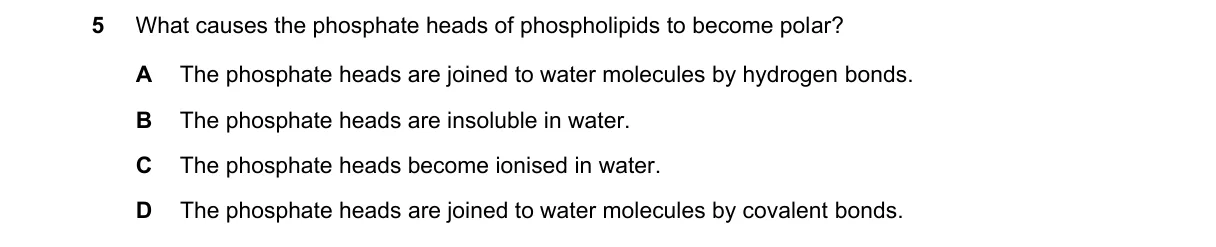
What causes the phosphate heads of phospholipids to become polar?
Answer choices
- AThe phosphate heads are joined to water molecules by hydrogen bonds.
- BThe phosphate heads are insoluble in water.
- CThe phosphate heads become ionised in water.
- DThe phosphate heads are joined to water molecules by covalent bonds.
Explanation
Ionization confers polarity to phosphate heads
Steps:
- Recall that phospholipids have hydrophilic heads and hydrophobic tails.
- Identify the phosphate group in the head as key to hydrophilicity.
- Understand polarity arises from uneven charge distribution.
- Determine that water's solvent properties cause ionization, leading to polarity.
Why C is correct:
- Phosphates ionize in water by dissociating into charged species (e.g., PO₄³⁻), creating dipoles per the definition of polar molecules as those with partial charges.
Why the others are wrong:
- A: Hydrogen bonds form due to existing polarity, not cause it.
- B: Phosphate heads are soluble (hydrophilic) in water, opposite of insoluble.
- D: Covalent bonds do not form with water; interactions are non-covalent.
Final answer: C
Topic: Fluid mosaic membranes
Practice more A Levels Biology (9700) questions on mMCQ.me