A Levels Biology (9700)•9700/13/M/J/24
A Levels Biology (9700) — 9700/13/M/J/24, Question 40
Influenza is an infectious disease caused by a virus. It is possible to have influenza more than once. Which statements explain why it is possible to have influenza more than once? 1 The virus antigens change as a result of mutations. 2 The immune system may be weak and make few B-memory cells. 3 Untreated HIV infection results in T-helper cell
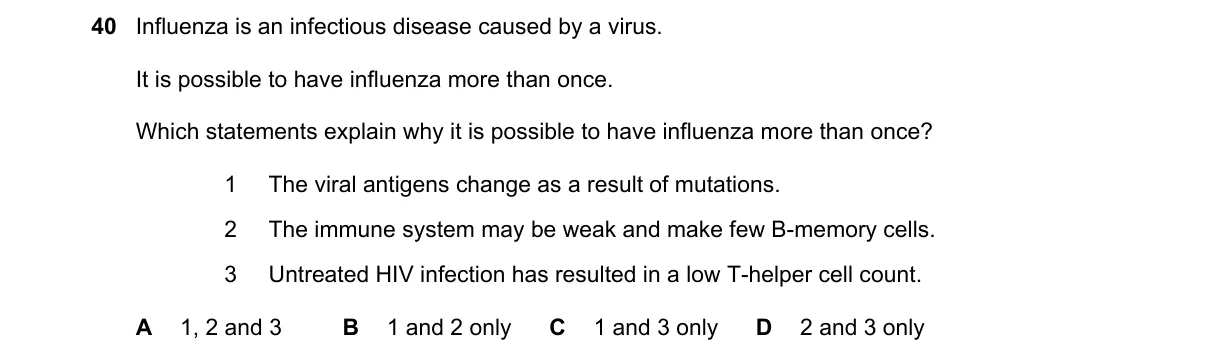
Answer choices
- A1, 2 and 3
- B1 only
- C1 and 3 only
- D2 and 3 only
Explanation
Recurrent Influenza Due to Viral and Immune Factors
Steps:
- Evaluate statement 1: Influenza viruses mutate, altering antigens (antigenic drift/shift), evading prior immunity.
- Evaluate statement 2: Weak immunity produces fewer B-memory cells, reducing long-term antibody response to the virus.
- Evaluate statement 3: Untreated HIV depletes T-helper cells, impairing overall immune coordination against influenza.
- Combine: All three explain reinfection by bypassing or weakening adaptive immunity.
Why A is correct:
- All statements align with immunology principles: antigenic variation and immune deficiencies allow reinfection, as memory responses fail.
Why the others are wrong:
- B omits immune weaknesses in 2 and 3, ignoring non-viral reinfection causes.
- C excludes 2, missing how poor B-cell memory enables repeat infections independently of HIV.
- D ignores 1, the primary reason for influenza's annual epidemics via mutation.
Final answer: A
Topic: The immune system
Practice more A Levels Biology (9700) questions on mMCQ.me